Yesterday I attended the North Carolina Trombone Festival, held at Appalachian State University this year. It was a wonderful time. I heard two very fine trombone choirs perform, the ASU Trombone Choir and the Charlotte Trombone Collective. The Performer’s Showcase Recital featured a number of the guest artists and most performed pieces I wasn’t familiar with already. I got to meet some colleagues from around North Carolina that I haven’t met before and also finally met a couple of teachers face to face for the first time.
There were also some workshops and I gave a presentation on brass embouchure technique and pedagogy in the morning session. While preparing for this I spent some time practicing it and recorded myself. Here is one practice session, unedited, but I think that it will get the points across pretty well. I didn’t write out everything I planned to say. Instead I had some bullet points of things I wanted to say in my presenters notes (as well as on the slides) and spoke about them off the cuff. I think that this makes a live presentation feel more natural, but on video it perhaps comes across better to recite something prewritten. What do you think?
At any rate, here is the practice session for anyone who is interested but wasn’t able to attend the festival or went to another workshop at the same time.
If you’ve read through some of my embouchure materials I’ve already posted here you’ll recognize the discussion as well as many of the examples I use. But it’s possible that this format and organization works well for some people as an introduction or review.
This Saturday, April 13, 2024 I’m attending the North Carolina Trombone Festival, as I mentioned last month. My presentation on brass embouchure technique and pedagogy will happen at 10 AM that morning.
Coming up next month, on April 13, 2024, I will be presenting at the North Carolina Trombone Festival. I will be giving an presentation on brass embouchure technique titled “Brass Embouchures: A Guide for Teachers and Players” at 10 AM.
The boilerplate release forms that I received to participate this year mention live streaming. If the event is streamed or recorded, I will be sure to post links here for folks who might want to tune in.
Regardless of whether it is going to be streamed, I will practice the presentation (in part so I can be sure to get through everything in the allotted 45 minutes) and will probably record my practice. If I get a decent practice recording I’ll post it too, so even if the NCTF doesn’t record or stream it you’ll be able to watch it later.
I recently got an email from a trumpet player, Lee, who reminded me about a topic I’ve been meaning to blog about for a while. In his email about a different topic Lee mentioned that the range requirements for trumpet player are more demanding than that of trombone. While on the surface this could be correct, I’m not so certain that this is really true. There certainly is a lot more nuance that goes beyond how high each of those instruments are expected to play. There’s also the range where these instruments spend the most time playing as well as the length of time in a given performance. Of course that’s going to depend also on the style of the music and what the individual piece is. It’s really hard to quantify this and often it gets framed as which brass instrument is harder to play, which is not really a useful argument.
Regardless, as someone who has spent a lot of time studying scores of great composers and arrangers I’ve noticed that the playing demands placed on different brass instruments are not always comparable. A phrase played on a Bb trumpet in a particular range is going to have a completely different quality if played an octave lower on a trombone. A trombonist pasting out an F above high Bb can sound exciting, but it doesn’t have quite the same punch as the equivalent G above high C on trumpet. Then we also need to consider how much a particular brass part plays on a given piece of music. If I were asked to play a NOLA brass band style sousaphone part in the equivalent range on tenor trombone or euphonium I think I would be gassed by the end of one set, maybe sooner. Good arrangers come to an understanding of what good brass players are capable of and write parts accordingly.
Are there some ways to objectively look at the playing demands placed on different brass instruments? Maybe, but all the ways I can think of have their limitations. Still, I find this an interesting thought experiment and did some “back of the envelope” analysis to see if I could come up with anything that might tease out an understanding.
While I’m not really a brass doubler, I do find it useful to practice trumpet from time to time and while I was a student, particularly in high school, I played all the brass instruments in different ensembles. I also taught all the brass instruments for a while back when I was teaching at Adams State College and ended up working on my chops on all the brass to try to be able to keep up with my students. But honestly, I found it more effective to simply transpose and play along on trombone with my students on other brass instruments because it provided a better model. I’m providing this background simply to point out that I’m not completely inexperienced on every brass instrument, but also to acknowledge that I’m only expert on trombone (and some might argue not even on that). My background as a composer and arranger writing for brass might be more relevant, since I’ve had a chance to discover through trial and error what works well for different brass.
Suggested Ranges – Orchestral
The easiest way to look at the demands on brass range I could think of was to look at orchestration and arranging sources to see what is recommended by experts. Are trumpet players generally required to play a greater range than tubists? Which brass instrument seems to require the widest range or the highest range? For my purposes in this post I’m going to focus on trumpet and trombone in particular, but also discuss tuba and French horn when I have some info to share.
One of the first books I was assigned as an undergrad for scoring music was The Study of Orchestration, by Samuel Adler. I have the 2nd edition, so your copy might be different. If you’re not familiar with this text, it is largely concerned with orchestral arranging, so these ranges might seem a little smaller if you compare this to big band playing.
Bb Trumpet
This text suggests a range of 2 octaves and a minor 6th for trumpet. The highest recommended note is the 9th partial. The Adler text also helpfully describes the characteristics of the registers for each instruments. For trumpet it describes the lowest written F# to the B above as “rather dull,” the middle C to A above the staff as “clear bright and most articulate,” and B above the staff to the D above the staff as “brilliant but strident.”
French Horn
Horn is a different animal than the other brass instruments. The fundamental pitch of the instrument is actually lower than a trombone, but they tend to be scored on higher sounding pitches. The range demands on a horn are larger than on the other brass, Adler recommends a playable range of just under 4 octaves. We are cautioned, however, that the lower register are difficult and to be avoided in fast passages. Written C below middle C up to G below middle C is described as “dark and may be a bit unfocused.” Above that to written middle C is “deep and solid.” From there to G on top of the treble clef staff is “bright and heroic” and above that is “brilliant and loud.” The highest suggested note is way up in the partials and I’m too lazy to count and figure it out. If you’re a horn player help me out in the comments.
Tenor Trombone
The suggested range for a tenor trombone is 2 octaves and a diminished 5th, a whole step smaller than trumpet, but then Adler provides some additional upper register notes in the parenthesis. Adler writes, “Theoretically, the quarter notes . . . are possible, and many professional players can play them, but they are difficult and risky.” If we included the highest note in the above suggested range the tenor trombone has a range of 3 octaves and a minor 2nd. The lowest pitch up to the G on the bottom of the bass clef staff is described as “dark and rather nondescript.” From there to the F above the bass clef staff is labeled as “very strong.” G above the bass clef to the Bb whole note in the tenor clef above is “very intense.” The highest suggested whole note is the 8th partial.
Tuba
Adler’s suggested range for writing for tuba is 3 octaves and a major 2nd, but it is covered in the text that tubists will often play instruments pitched in different keys. The lowest suggested pitch above, F, to the Bb two ledger lines below the staff is described as sounding “deep and heavy.” From the C below the staff to E in the staff is indicated as sounding “very strong” and above that is “getting weaker but quite intense.” The highest recommended pitch for tuba is the 13th partial, I think.
“Winner of the Range Contest”
It’s not a contest, but the horn wins with almost 4 octaves. Tuba comes in second with 3 octaves and a major 2nd. Trumpet and trombone are about the same, roughly 2 and 1/2 octaves, depending on which pitch you go with for the highest recommended note on trombone.
Suggested Range – Big Band
For suggested ranges for big band writing I grabbed Nelson Riddle’s text, Arranged by Nelson Riddle. I’ve got several good books on arranging for big band, this just happened to be the first one that I grabbed off my shelf.
Trumpet
This suggested range is very close to Adler’s suggestions. For some reason the lowest note is a half step higher, so 2 octaves and a Perfect 4th. If you know Nelson Riddle’s arranging you know that he would often write his lead trumpet parts higher than suggested.
Trombone
Riddle describes the recommended range of the trombone differently from the trumpet, like Adler. The two notes at the beginning of the above example are almost the same as the equivalent trumpet range, 2 octaves and a diminished 5th. But Riddle also adds some pedal tones (personally, I wouldn’t recommend too many pedals on tenor trombone and the lowest I can think of in classical repertoire is the pedal G in the David Concertino for Trombone and Orchestra.) He clarifies his upper register suggestions as “The upper notes. . . are all practical and easily available to experienced professionals, but younger and weaker lips usually have ‘A’ or ‘Bb’ as a ceiling, and the high ‘D’ in particular seems to be the starting note of a kind of ‘stratosphere’ which is closed to all but the very finest players.”
French Horn
Riddles range suggestions for horn are difficult to follow. The above image is a recreation of what is in the book, but there’s not much description on what all that means. He covers the French horn in his chapter on woodwinds and then later in the chapter on brass. I may be missing a complete discussion on what ranges he recommends for horn, since I’m skimming.
Tuba
Riddle’s suggested range for tuba is a bit smaller than Adler’s, 3 octaves total.
“Winner of the Range Contest”
Again, not a contest, but at least according to Riddle the tuba “wins” at 3 octaves. I won’t attempt a guess as to what he feels is the playable range for the horn. The trombone might be considered to eke out the trumpet a hair. That said, I tend to think of the playable ranges of trumpet and trombone as being equivalent to each other (for professional players), but with some caveats that I mentioned earlier and that I’ll get into now.
Playing Demand Comparisons – Big Band Lead Trumpet and Lead Trombone
Something important for composers and arrangers to consider when writing for brass is how much time the players spend actually playing and how much rest they get in a given piece. Nelson Riddle notes, “The brass section should be used for punctuation and support, and should not be given the sustained passages you would assign to string players, who can saw away for hours without rippling a muscle or generating one drop of perspiration.”
Since most of my own writing and much of my playing is for big band, I’m most familiar with that repertoire. One thing I’ve noticed with most of the great arrangers is that the trumpets generally are used more sparingly than the trombone section. I think there are two main practical reasons why. First, the lead trumpet part in the upper register is often saved for the exciting shout chorus and it’s helpful to give the trumpet section a chance to rest a bit before they are required to play up there. Secondly, the range of the trombone section alone is a bit more rich and solid sounding than a the trumpet section up an octave by themselves. While there are certainly times when the trumpet section can carry a passage on their own, it’s more common for that section to be blended with the saxophone or trombone section. You don’t have to go very high before 4 trumpets alone start to sound “tinny” whereas the trombone section voiced an octave below is in a range that sounds rich and clear.
But I wanted to come up with a more objective way to measure my impressions here. I grabbed a chart out of my own library, A Little Minor Booze by Willie Maiden, written for the Stan Kenton Orchestra. I figured something out of the Kenton library might make for a representative sample of what is expected in modern big band playing. I looked at the lead trumpet and lead trombone parts and worked out a couple of different things that would give us a glimpse into the different playing demands. I worked out the required range for both parts, but also looked at what the average note and median note was for both parts. I also looked at how much of the chart each player would have the metal on the mouth. It’s not really an accurate comparison, a quarter note playing a 6th partial concert F isn’t as demanding as playing that same pitch for a whole note. Controlling for that sort of variable is too much work for a blog post (and just guess at how much effort it took to write this post already), but I think it could be done if someone was interested enough.
Here are the results using some charts to compare.
Following this chart takes some explaining. In order to easily calculate these numbers I assigned the number 1 to the concert E below the staff for both trumpet and trombone (the lowest recommended non-pedal tone note for both). The F above that was assigned the number 2 and so on, all the way up to the written “double C” on trumpet at number 43. Here’s another way to look at this data.
Lowest Pitch Played
Lead Trumpet (written)
Lead Trombone
The lead trombone part was required to play the equivalent of an octave lower than the lead trumpet part.
Highest Pitch Played
Lead Trumpet (written)
Lead Trombone
On the second to last measure the lead trumpet has to play a “double C.” This is a major 6th higher than the equivalent highest note on the lead trombone part. The lead trumpet part has an entire range of two octaves, the C in the middle of the staff to the C two octaves above. The lead trombone part has an entire range of 2 octaves plus a minor 3rd.
Average Pitch
Lead Trumpet (written)
Lead Trombone
The average pitch for the lead trumpet part came out to a diminished 5th higher than the lead trombone part.
Median Pitch
Lead Trumpet (written)
Lead Trombone
The median pitch, that is the middle between the highest and lowest notes played in both parts, has the lead trumpet part a major 3rd above the lead trombone part.
Mode Pitch
Lead Trumpet (written)
Lead Trombone
The mode pitch refers to the pitch that occurred most often in the part. The lead trumpet mode note was the equivalent of a Perfect 4th higher than the mode note in the lead trombone part.
Measures Spent with the Metal on the Mouth
Lead Trumpet
Lead Trombone
The entire chart of A Little Minor Booze is 108 measures long (not counting the quarter note pickup). The lead trumpet part has at least one note in 33 measures, compared to the lead trombone part having 53 measures with something to be played.
Summary Impressions
First of all, let me make it clear that all the above really doesn’t tell us which brass instrument is the most demanding to play, but it might give the composer/arranger some ideas on what brass are capable of and how to write more idiomatically for those instruments. For big band writing in general, my best guess is that the lead trumpet will typically be required to play higher, but the lead trombone part will be required to play a wider range in general. The trombone section will typically need to play for longer periods of time with less rest, whereas the trumpets, who probably need to play more in the upper side of their range, will get more rest. If you want your trombone parts to be higher than typical you might want to write them with more rests than normal. Likewise, if you want your trumpets to play more throughout your arrangement you should write their range lower than you might otherwise. If you want to look at which instrument is required to play the widest range in general, you can probably assume French horn can cover the most range, followed by tuba, trombone, then trumpet.
My general thoughts on range capabilities for similarly experienced brass musicians is to pretty much think of them as the same. Take the roughly 2 and 1/2 octaves for trumpet and transpose that down an octave for the range of trombone and euphonium. Drop that down an octave for tuba standard range. Those aren’t perfect, but they will give you a decent idea to work with so that instead of having to memorize ranges for 3 different brass instruments you memorize 1 range and transpose by octaves. French horn, of course, is different and you’ll need to learn their range if you’re going to write for that instrument effectively.
To be honest, I’m not sure how effective this will be for teaching brass players how to flutter tongue. If you came here looking for help learning to flutter tongue please leave a comment after trying this out and let us know if it helped.
Flutter tonguing is an effect that brass players are sometimes asked to play that provides a raspy or growling effect. I use it quite frequently when I’m playing plunger trombone solos. But many brass musicians have trouble with it and simply can’t do it.
The technique itself is, I feel, almost identical to rolling your “R’s,” something that is common with some languages like Spanish. I never had any trouble with this, so when it comes to teaching it I have been at a loss. But recently I happened to come across this YouTube video from the Breakthrough Spanish channel, teaching how to roll your “R’s.”
One of the takeaways I got from this video is how rolling your “R’s” is more difficult with a harder consonant before it. When we articulate notes on brass most of us will employ a “T” or “D” consonant to start the pitch, but if we’re articulating too hard on the beginning of that note it doesn’t allow the tongue the flexibility it needs to flutter. One key to learning how to flutter might be lightening up on the initial attack or trying it out with a breath attack.
I suspect that the “ara” trick explained in this video might also be very helpful for developing a good flutter tongue. Quite often I find that tweaking a playing technique away from the instrument and then transferring that skill to playing is a very effective practice approach.
If you can’t already flutter tongue and try this out, please come back and let us know in the comments how it worked for you.
It’s been a while since we’ve played “guess the embouchure type.” I recently came across this video of a very fine up-and-coming horn player, Josh Williams. Take a close look at his embouchure in this video and see if you can guess his embouchure type. My guess after the break.
YouTube user “Trumpet Thoughts” (Donovan) put together a video that describes the three basic embouchure types using Donald Reinhardt’s terminology. I found it to be a pretty good basic description of the three basic embouchure types.
If you followed my link above the video you’ll see one of my summaries of these three basic embouchure types. Reinhardt did distinguish embouchure types into more detailed categories than the three basic ones, but these three types are enough to describe any functioning embouchure. The only difference between some of Reinhardt’s less common embouchure types and the three basic types is often just the position of the musician’s jaw while at rest. For a little more detail about these embouchure variations you can see my Reinhardt/Elliott Embouchure Type chart.
For example, my own embouchure technically would be categorized as a Reinhardt IVA embouchure type. In other words, I have a low mouthpiece placement so the air stream is directed up, and I pull my lips and mouthpiece together down to ascend (which Donovan discusses as a “pivot” in his video). But the only difference between my embouchure and Donovan’s is that I play with a receded jaw position and have a lowered horn angle.
Horn angle can be a very personal embouchure characteristic, even between players of the same embouchure type. If you look around my web site you’ll see some examples of Very High Placement (Reinhardt IIIA) embouchure type players that have the typical straight out horn angle, but some play better with a receded jaw position and a lowered horn angle. Most Medium High Placement (Reinhardt IIIB) embouchure type players have a receded jaw position and a lowered horn angle, but there are also many who play best with a horn angle close to straight out.
Reinhardt felt the lowered horn angle on an upstream player to be important enough to warrant its own embouchure type. On one of his instructional tapes he described a IVA.
I almost think of a Type IVA hasn’t developed and [is a] Type IV that hasn’t gotten around to being a Type IV, if you know what I mean. In other words, the horn is on its way up but never got there, so to speak.
So You Think You’re a Type IV – Donald Reinhardt instructional tape
On that particular tape (and on others) Reinhardt discusses working with a student’s horn angle by having him or her practice with it too high and too low for periods of time, then “whittling” the horn angle in over time. And you can also certainly find downstream embouchure type players who have horn angles that are different from what is typical. To my reasoning, a Low Placement embouchure type with a lowered horn angle (Reinhardt IVA) is really no different conceptually and doesn’t really require any shift in pedagogy from standard Reinhardt type IVs. Nor does it seem to be that much different from a Very High Placement (Reinhardt IIIA) who plays better with a lowered horn angle.
Horn angle is a continuum. At what point does a Type IV become a IVA? With any student, regardless of embouchure type, I want to help the student work out their own idiosyncrasies, including, but not limited, to where their horn angle works best for any particular note. With similar horn angle variations found in all the embouchure types I don’t see a need to separate the upstream embouchure type performers according to their horn angle.
A recent discussion on TromboneChat discussed playing pedal tones and whether or not it is appropriate to switch embouchure types for playing the pedals. Specifically, whether it’s helpful for a downstream player to change to upstream or vice versa. One participant wrote:
If you are a high placement downstream player, reverse your playing to upstream for pedals. I don’t know how you would do it if you are an upstream player already.
Basically, the airstream needs to aim more or less right at the mouthpiece throat.
First, it’s important to understand and define what upstream and downstream embouchures actually are. Follow the above link to read and watch some details, but to summarize when a brass musician places the mouthpiece with more upper lip inside the mouthpiece the air gets blown in a downward direction. When the mouthpiece is placed with more lower lip inside the air stream direction is blown up. This embouchure characteristic can be found on all functioning brass embouchures, regardless of how the musicians feels is what is happening. It’s not directly related to the position or the jaw, it’s the mouthpiece placement that makes the air stream blown up or down.
It is definitely true that as a brass musician plays lower the air stream will be blown closer towards the shank of the mouthpiece. But I don’t feel it should switch air stream direction. In fact, I don’t buy that this is actually happening with the examples shown or discussed in the Trombone Chat topic. For example, one participant feels that this film of George Roberts playing a pedal F demonstrates a switch from upstream to downstream.
Notice that in this video that Roberts places the mouthpiece so that there’s more upper lip inside. The upper lip predominates and overlaps the lower lip. The film maker, Lloyd Leno, even classifies Roberts as playing with a downstream embouchure. I don’t see anything in this film clip that would indicate Roberts flips his air stream from downstream to upstream for this pedal F. Certainly the air stream is directed closer to blowing straight into the shank, but I don’t think it’s reversing and blowing upstream.
If you’re not convinced, let’s take a look at a bunch of different trombonists playing a pedal Bb. First, let’s look at the more common downstream types.
Downstream Pedal Bb
The above photo captures the aperture close to its most open position and the air stream does look like it might be being blown straight into the shank. Note the slight overlap of the upper lip over the lower.
This player shows a similar lip position as the player above. Both players place their mouthpiece quite close to half and half, perhaps too much so. Again, notice how the lips are lining up. In this case the upper lip doesn’t look like it overlaps quite as much over the lower.
This one doesn’t have the best angle, but you can see the upper lip overlapping the lower lip slightly. Here’s several more.
You get the idea. In the above examples there is more upper lip inside the mouthpiece and the upper lip slightly overlaps the lower. This upper lip overlap is easier to see in higher register notes because the air stream is blown more sharply downward, but the same general lip position is present on the pedals too.
I want to point out that some of the above players reset their mouthpiece placement to a more centered placement to play pedals. This is something I advise against, but it’s important to notice this fact because it is something that happens with upstream trombonists as well.
Let’s compare the downstream players with some photos of upstream trombonists playing a pedal Bb and see if there’s an obvious difference.
Upstream Pedal Bb
The glare off the flash on the mouthpiece along with the position the lip aperture happened to be in makes it a little harder to see, but notice the mouthpiece placement allows for more lower lip inside. This trombonist resets the mouthpiece to a position closer to half and half for pedal range – and example of “shifting” to play pedals that I advise against. If you rely on resetting the mouthpiece for pedals you’re always going to have trouble getting in and out of the pedal register. It’s best to learn to play pedals in a way that matches your embouchure form for the normal playing range.
This upstream trombonist also resets the mouthpiece to a more centered position. You can see the loose right mouth corner. Collapsing the embouchure formation to descend is a common issue. Those features aside, notice the lower lip is overlapping the upper lip slightly. There is a distinctly different lip position compared with the downstream embouchures.
This upstream trombonist has a placement close to half and half for his entire range. I didn’t capture the aperture in a very open position for the above photo, but that is a pedal Bb. Photos of this musician playing higher notes shows it much more clearly as an upstream embouchure. Again, notice the lip position and compare to the downstream players.
This photo got the aperture in a position that makes it easier to note the upstream air direction for a pedal Bb. Notice how the lower lip predominates and overlaps slightly.
Here’s another example. The glare of the flash again gets in the way a bit, but you can see the predominance of the lower lip inside the mouthpiece and the lower lip is slightly in front of the upper. This is opposite of all the downstream examples.
The above photo is me playing a pedal Bb. My friend didn’t quite get the side angle I had with the other photos, so it’s harder to see the lower lip coming out in front of the upper, but you can clearly see how much more lower lip is inside the mouthpiece.
There is a general type of lip position you can see inside the mouthpiece that is different between downstream and upstream brass musicians. If you take the time to look closely at a number of different brass embouchures like this you’ll become adept at spotting the difference. Look closely at the above photographs and also the entire Leno film I embedded above and look for which lip tends to overlap the other. With downstream players the upper lip will be slightly in front of the lower while with upstream embouchures you’ll see the lower lip slightly in front of the upper. It doesn’t matter what the horn angle is or jaw position, the mouthpiece placement makes the embouchure upstream or downstream. Notice in the above photo examples that you can find players with receded or aligned jaw positions playing upstream and downstream.
One thing that you won’t be able to see in just the isolated photographs is that there is a gradual adjustment of the air stream direction from high to low. When a downstream embouchure brass musician plays in the upper register the air stream is blown more sharply downstream and when that musician plays in the lower register the air stream will be blown at a smaller angle downward. This is reversed for upstream embouchures. The Lloyd Leno film I embedded above shows this pretty clearly in slow motion.
So the question is whether or not it’s appropriate to change embouchure types for pedals. As a tenor trombonist, I don’t need to perform pedals very frequently and generally the context in the tenor literature for pedal tones are such that if I did need to reset or make a radical shift in my embouchure to get pedal tones out I probably could. So you could make an argument that as long as this shift doesn’t happen in the normal playing range it’s no big deal.
That said, I think it’s best to avoid any embouchure type switching or radical shifts in embouchure, regardless of what range it’s in. For one thing, shifting back and forth will cause a noticeable break in the embouchure and right at that switch you’ll be able to see and hear something happen. Here is an example of this happening in the normal playing register on a tubist.
Notice the lip position inside the mouthpiece. For his lower register his lower lip predominates and the embouchure is upstream. In the middle of his register he flips lip position and the upper lip begins to predominate and the air will be blown downstream. He’s quite adept at going back and forth, but you’ll hear that he almost always cracks the notes around the break. When asked to play something that happens right at this switch things can easily break down.
This tubist happens to have a mouthpiece placement too close to half and half, so he is unable to keep the embouchure functioning for the entire range as either upstream or downstream. Notice that his type switching happens without a radical change in jaw position or other shift that might be noticeable if you don’t know what to look and listen for.
Something similar can happen for trombonists when they play pedal tones, but the same disadvantages that the above tubist is dealing with apply. Again, you could make the argument that a tenor trombonist who plays pedals infrequently shouldn’t worry too much about playing the pedal range differently, but if that embouchure type switching creeps into the normal playing range it will be more problematic. Regardless, I feel that spending time in the practice room to minimize or eliminate any unnecessary or drastic shifts in embouchure technique is better – even for the pedal register.
For years I’ve been coming across advertisements for the Stratos, invented by trombonist Marcus Reynolds. I first heard about this device about 10 years ago, in 2013, and wrote up my initial thoughts here. In 2014 I came across another video from Reynolds and wrote my impressions of that video here. Reynolds is a tireless promoter and I’ve been seeing more and more of his posts and videos about this device the past couple of years, so I finally broke down and purchased one to see if it lives up to the hype.
Since this will be a long post, I’ll give you the tl/dr version up top – You can save your money. It’s possible that it can be used for a small number of embouchure tweaks, but it’s completely unnecessary and if you use it wrong it has the potential to hurt more than it helps. Using it correctly is harder than you might think. Reynolds’s instructions don’t take individual differences into account or certain embouchure mechanics that the Stratos interferes with.
What is the Stratos?
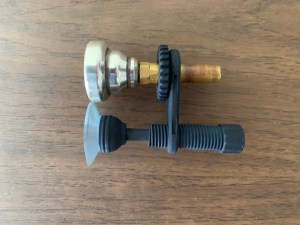
The Stratos is a device that is designed to attach to the shank of your mouthpiece. An adjustable rod with a suction cup then is set so that it rests against your chin while you play. There is some give with the chin rest due to a spring set up inside, but the general idea is that it will keep you from pressing the mouthpiece hard against the lips. There are two versions. The original is called the Stratos Encore Pro and costs £249.99 ($313.04 currently). A less expensive version, 3D printed I believe, is called the Stratos Performer and costs £79.99 ($100.17). They aren’t cheap and that doesn’t include shipping costs.
The inventor, Marcus Reynolds, is a U.K. based trombonist of some note. His embouchure bonafide comes from his experiences relearning how to play following an accident which pushed his mouthpiece through his top lip. After an operation he also apparently developed focal task specific dystonia in the embouchure. He diagnosed his initial return to playing as being held back by “lactic acid trying to repair the scar tissue” and invented the Stratos as a way for him to practice with the mouthpiece rim “hovering” over the scar tissue. Today he has returned to performing professionally and tirelessly promotes the Stratos.
When you order the Stratos Performer it will come unassembled and you’ll have a sheet of paper giving you a brief overview on how to assemble it, as well as a typed out link and QR code to a YouTube video that goes over putting it together. The typed out link was broken, but the QR code did direct me to this video. I did not receive any instructions from Reynolds on how to use the device with my order, so I had to do my own internet searches and reached out directly to him.
What Are the Claims?
Before I go into details on my personal thoughts, I think it’s helpful to take a closer look at the inventor’s claims and learn whether they hold water.
Air Stream Direction
The above video is one of the earlier ones you can find, I think originally made as a DVD that shipped with the original Stratos. Reynolds states:
What should happen is that the air you are buzzing through the mouthpiece should flow through the center of the shank of the mouthpiece. In many cases with amateur and professional alike, this is not necessarily the case and you will not be aware that they is in actual fact being directed by your lips into the bottom of the mouthpiece reducing the power and effectiveness of the air produced making it more difficult to reach the pure note you seek. Especially when you are playing notes in the higher register. If your teeth are not aligned when you play the air produced will be directed downwards hitting the bottom of the cup of the mouthpiece.
While Reynolds does acknowledge upstream and downstream embouchures here, blowing straight into the shank does not happen with well-functioning brass embouchures. The Stratos won’t help you blow straight into the shank, and if it does you’re moving in the wrong direction. This claim has been thoroughly debunked for quite a while – including by one of the sources that Reynolds cites (I guess he didn’t actually read the book).
I asked Reynolds a couple of times about this claim and never got a straight answer from him. It’s possible he’s modified this idea now.
Jaw Position and Teeth Alignment
The prime function of Stratos is to enable you to position your jaw and teeth correctly allowing you to position your lips on the mouthpiece with less pressure and maximum air power with minimal effort and maximum results.
“Correctly” in this context, according to Reynolds, is to position the jaw so the lower teeth and upper teeth are more or less aligned. Lining up the teeth works great for many players, not so well for others. This is personal. Reynolds assumes that what works for his physiology will work for everyone. There are just too many examples of excellent brass musicians who play with a receded jaw to assume that aligning the teeth is correct for everyone.
I think it’s likely that Reynolds allows for different positions of the jaw, including a receded jaw position or even one whether the jaw protrudes so the lower teeth are in front of the upper teeth. However, that’s not how he instructs people to use the Stratos, and it really needs to be made clearer in the instructions if my assumption is correct.
Mouthpiece Pressure
Mouthpiece pressure is more complex than Reynolds gives it credit. It’s been shown that we use more pressure than we realize in normal brass playing and also that we’re terrible judges of how much mouthpiece pressure an individual player is using in the first place.
In my experience excessive mouthpiece pressure is a result of something else not working correctly. When you fix the actual issue the mouthpiece pressure will usually reduce on its own. In fact, many players don’t use enough mouthpiece pressure, particularly in the lower register. Often they have trouble with applying a proper amount of mouthpiece pressure because they are not firming their lips up enough to accept the normal amount of pressure necessary for efficient playing in the first place. Reducing mouthpiece pressure as an a priori assumption is hit or miss at best, you need to understand overall embouchure form and function and the relationship mouthpiece pressure has in the bigger picture.
In other videos Reynolds makes a big deal about reducing mouthpiece pressure so that the blood can flow to the lips. In Part 3 of the original DVD he states, “I think the more blood can get in there the more strength there is. . . This pressure pushes the blood away.”
I don’t have any serious medical training or formal study of anatomy, so you can take my thoughts with a grain of salt. I don’t think Reynolds knows what he’s talking about either, though. I suspect that if we were actually starving the lips of oxygen from lack of blood flow that we would see the lips turning blue and have other more serious issues than a red ring on the lips. Don’t worry about a red pressure ring on the lips from the mouthpiece rim, that happens to a many players and doesn’t suggest you’re using too much pressure.
Why Is This Important?
All of the above premises are dubious claims at best and outright wrong at worst. Now that doesn’t mean that the Stratos is useless, but it was designed under false premises. If the rationale behind why the device was invented is faulty in the first place then it stands to reason that the conclusions of what it’s actually doing are probably wrong too,
The lack of understanding about basic embouchure characteristics such as air stream direction, jaw position, and teeth alignment are huge red flags to me. I don’t feel that Reynolds truly understands brass embouchure technique as well as he thinks and what he suggests that the Stratos is doing for one’s playing is not the case. Nor is what Reynolds recommends going to be correct for many brass musicians.
How To Use It According To Inventor
I mentioned above that I had to go out of my way to find instructions on how Reynolds advises students to use the Stratos. I emailed him for help and he directed me to this video.
In this video Reynolds instructs us to set the Stratos up so that the chin rest and mouthpiece rim are lined up and play some simple scale fragments. Then you adjust it so the chin rest extends just a hair further and repeat. This will supposedly make it so that the higher pitches are as easy to play as the lowest note in the scale. As you continue this process of setting the chin rest even further past the rim you are instructed to keep the jaw forward, even though it’s being pushed back by the chin rest. When you reach this point the mouthpiece will only be lightly touching the lips with very little pressure. Continue until you’re essentially free buzzing into the instrument and practice like that for a bit. Then you pull back the chin rest so that it’s far enough to not contact the chin at all and play. In comparison “the note just flew out,” as Reynolds proclaims when he plays with the chin rest off. You’re supposed to practice about 10 minutes a day like this with the Stratos, then take it off. If you revert back to your “bad habits” you put it back on for a bit.
How well did the above instructions work for me? It was disastrous when I followed it to the letter. I absolutely play better with a receded jaw position and my horn angle tilted down. Starting with the chin rest aligned with the mouthpiece rim was already at the point of where it was sounding terrible and too much effort to play. Sure, I’m not using nearly as much mouthpiece pressure as I usually do, but that’s not really a good thing. I can confirm that when you position the chin rest all the way back and return to playing as normal that the note will “just fly out” like Reynolds claims in the above video. The comparison of how easy it is to play without the Stratos felt easy because I just spent 10 minutes trying to play wrong. It’s like hitting myself in the head with a hammer – it feels good when I stop.
If you’re a brass musician like me who plays best with a receded jaw position you might be able to learn something by practicing in a way that is actually incorrect for a bit, but you’re risking messing up your chops by following Reynold’s instructions. Instead, you should probably start with the chin rest in position where it works best. When I switched to starting with the Stratos set up in my normal playing position I got results more similar to Reynolds’s demonstration video. But that just means it sounded worse and worse until I stopped using the Stratos. Again, it feels better when I stop using it – not because it’s helping me play more efficiently but because I stopped playing wrong.
What It’s Actually Doing and What It Could Actually Be Helpful With
The Stratos does make you play differently, just not in a way that is accurately described by Reynolds. With some understanding of how brass embouchures actually function there are a couple things that the Stratos could have some possible use for.
The best use I found from practicing with the Stratos was using it to provide tactile feedback on the jaw. The position of the jaw is a very important part of a brass musician’s embouchure. For a player with a habit of keeping the jaw in a position that is less than ideal for their anatomy, you could use the Stratos to provide some tactile feedback as to whether the jaw is in the correct placement. For players who open their mouth wide to breathe or drop their jaw to descend you could use the Stratos to again help the player notice more readily when they are pulling their jaw out of the correct position.
But that use needs to first come with an understanding of where the jaw should be for the individual player. I guess you could also use the Stratos to help find the correct position of the jaw by gradually adjusting the position of the chin rest as described above, but I find it easier to simply move the horn angle and have the student follow the horn angle with the jaw while listening to intonation and tone. I’ve had pretty good success helping students find their individual correct jaw position and horn angle without any devices. It’s at least as effective, and a whole lot cheaper.
Other than this form of external feedback on the jaw position, I didn’t find there to be any real value in practicing with the Stratos. Furthermore, I feel that everything that it can do for your embouchure technique can be done just as easily without it, provided you have the background to understand how your embouchure functions correctly.
What It’s Hindering
While I anticipated the Stratos would interfere a great deal with the embouchure motion, I was surprised that it was easier to push and pull my lips and mouthpiece and slightly alter my horn angles than I expected. That said, it still is inhibiting my ability to freely make those necessary alterations and my playing is just a bit sloppier than without it on. Some players might find their embouchure motion is static enough that it’s not a big deal, but I found using it discouraged the correct changes I need. If you need to reduce the amount of embouchure motion and horn angle change that you use there are easier (and cheaper) ways to go about it than using the Stratos.
The instructions don’t go over using the Stratos to find the correct jaw position for a player who correctly plays with a receded jaw. I don’t know for sure if Reynolds would allow for this in a private lesson, but his online videos ask you to start with the chin rest and rim aligned and then protrude the chin rest even further from there. If you follow his instructions literally and happen to be a brass musician who plays correctly with a receded jaw position this is not going to be helpful.
When positioned in a particular way the Stratos does indeed make it so you have to use less mouthpiece pressure. As I mentioned earlier, in my experience it’s more common to find players who don’t use enough mouthpiece pressure, so in this case reducing the mouthpiece pressure is the opposite of what they need to move towards. For players who are using too much mouthpiece pressure there are usually other things that are not working correctly so that the musician is relying on the excessive pressure as a crutch. With an understanding of embouchure form and function you can fix the cause of the symptom and usually the excessive pressure will go away on its own. Simply reducing mouthpiece pressure on its own is treating the symptom and not fixing the actual problem. There may even be some risk of injury for players when they take the Stratos off to play if they don’t make the necessary correction to their embouchure form.
So You Still Want To Learn More
If you really want to learn more about the Stratos it’s quite easy to get in touch with Reynolds. He’s very accessible and seems genuinely excited about the Stratos. You can contact him through his web site and watch his videos on YouTube. He also is the administrator of a Facebook group (mis)named “Brass Embouchure Advice,” which you can search for on Facebook and join if you’re so inclined. Keep in mind any advice you get there is almost certainly going to be recommending the Stratos. Reynolds states, “All my students had success with it. It’s almost a device that cannot not work.” (I don’t believe this to be the case). Advertisements of anything other than an endorsement of the Stratos are prohibited, for the most part. In my experience trying to post in that group I often had long delays in getting my posts approved and actually was banned for a while simply for posting this link.
As I said, Reynolds is easy to reach and enthusiastic about the Stratos. After mine arrived I reached out to him by email and he offered to give me a lesson (he would have charged $100) with a money back guarantee if I didn’t find it helpful. I tried to schedule something with him during my spring break when I had a lull in my schedule, but between both of our busy schedules and the time difference we weren’t able to find a time to get together. It’s possible that my opinion of the Stratos would have changed with a lesson from its inventor, however I feel that I already know enough about brass embouchure technique to understand what the Stratos can actually do and how to do the same thing without it. But you might feel differently and if you are interested it’s probably not too hard for you to make that happen – provided you’re willing to drop over $200 on both the device and a lesson.
However, I feel you’ll need to take Reynolds’s advice with a grain of salt. In his instructional videos and other places online he mischaracterizes brass embouchure technique, often offering contrary descriptions of how things should function. It mostly seems he makes recommendations that describe how he thinks he plays, without consideration of what is actually happening and how it can be different from player to player.
Final Thoughts
The Stratos is expensive, overpriced for the value in my opinion. Everything that I might use it for can be done just as easily, perhaps better, without the device. There are some inherent risks using it that could lead you to habituating something that is wrong for your embouchure. You’ll need to make some effort to find instructions on how to use it, since it’s not obvious when it is shipped to you, unless you want to spend the money to catch a lesson directly with Reynolds. Furthermore, those directions are not universally good for all brass musicians.
My Stratos is now in my junk drawer with old mouthpieces and other things I don’t use. At some point I will probably try it out with a student, just to see what happens, but I won’t use it as suggested by Reynolds and I won’t recommend anyone spend the money to purchase their own.
If you have already contacted me about tomorrow’s brass embouchure Zoom hangout you should have gotten an email from me with the Zoom link. If you didn’t get it, please make sure you’re checking the email account you reached out to me and look in your spam folder, just in case.
If you can’t find it, please reach out to me again and let me know. If you didn’t let me know you’re interested already and want to participate let me know and I’ll send you the Zoom info.