Is there a “secret” to playing high notes on a brass instrument?
According to this video, it’s got something to do with the teeth and lips, but he’s not very clear on what he means. He talks about if you imagine the air passing over the tongue it hits the back of the teeth and then on the lips it forms a “thick” air stream. But we need a “thin” air stream to play high. He then demonstrates how he can place the mouthpiece in different (horizontal) placements that, I think he claims, naturally create a thin air stream for high notes.
But the key is his Mays Double-Aperture System (MDAS). This is used to unlock “High Note Air Jets” (HNAJ). He goes through a number of procedures to position the lower lip closer to the top teeth, position the top lip further away from the lower lip, curl the lower lip over the lower teeth, drag the lower lip so it’s in line with the edge of the lower teeth, direct the air up (with the jaw), experiment with horizontal mouthpiece placement (in order to find a place that “unlocks” air channels), experiment with vertical mouthpiece placement, and create “fast” air with “dry areas” of your lips.
Now I can see how some of this experimentation could lead to brass students finding a “sweet spot” on the lips that works best, but much of his description seems to be more his playing sensations or an analogy. This sort of experimentation done subjectively could just as easily screw a player up, in my opinion.
By the way, I would type his embouchure as a Medium High Placement type.
But there are a lot of more videos on YouTube that teach us the “secrets” to playing high. Let’s see what another says.
This video states that it’s tongue position. But he first describes that instead of going “up or down” on the center of the pitch we need to go “out deeper into the center of the instrument.” The lips, he says, are not the cause of the sound but rather just responding to everything else (most especially the oral cavity resonance). With the lip position what you want to do is think of the air column as a string. To go up an octave, you use the tongue position to “cut the air column in half.” He discusses a “half whistle,” which I like to describe as a pitched hissing instead.
Tongue position is an important part of the puzzle, and his idea of a “half whistle” is similar to something that I’ve been using in my own practice and teaching as well. But is it the “secret” to high notes for all players or does it depend on what the student is already doing and what direction they need to move towards? I think that in order for this concept to have such a dramatic effect the musician will need to have other things, like the embouchure and breathing, already pretty well in place.
By the way, my best guess for his embouchure type is the Very High Placement type.
In this video we learn a bit about how the brain is plastic and changes as we learn new motor skills, but it can adopt to incorrect technique as well as correct technique. So we need to practice correctly in order to reinforce efficient playing rather than incorrect playing.
Regarding the embouchure, he describes his as having an “open aperture.” The concept of an open or closed aperture to play a brass instrument is sometimes brought up, but people often use the terms differently and neither really describes what happens as a tone is being played. The aperture actually opens and closes throughout the playing. Regardless, he makes the connection between aperture size and dynamic (larger aperture for louder notes, smaller for softer) and range (smaller aperture for higher notes, larger for lower).
According to this teacher, we can create “compression” at three points in the playing apparatus; the lips, the tongue, and the glottis. Of the three, we don’t really want to do so at the glottis as that tends to cause playing issues. The tongue is used to create a resonance in the oral cavity to match the pitch being played, as described in the previous video. He briefly discusses a “modified yoga breathing,” which he describes as a process to breathe in first at the abdomen, then the intercostal muscles, and then then “claviculary” (at the clavicles). The goal of all of this is to remove excess tension, so I guess that’s the secret he’s talking about.
For descriptions and instructions on breathing I think I prefer to avoid the three-step process he advocates. I lean more towards how Arnold Jacobs would prefer to get the student taking a natural breath, using the sensation of moving air instead. Perhaps you could use those three regions as a guide for the teacher to use to see if the inhalation is working correctly, but Jacobs famously pointed out that you can imitate this body movements without moving the air correctly. It’s not the body moving that creates efficient and relaxed breathing, but rather efficient breathing that causes the body to move in the manner we associate as correct.
I can’t really guess his embouchure type from this video. Every time he plays the camera focuses on the bell of his trumpet and we can’t get a decent look at his embouchure. Probably one of the downstream types.
What’s the point of going through contrasting discussions on playing well in the upper register? Particularly since they cover some different things? Some players could definitely follow the advice of any of these videos (or the myriad of other videos purporting to offer the “secret”) and find something that clicks. But again, it really depends on what other playing factors are already in place and what needs adjustments.
With my personal interest in brass embouchure technique and pedagogy it’s very easy for me to break down the “secret” to opening up the upper register there. If I were to take it more personal, I might even advise all players to put as little upper lip inside the mouthpiece as possible and play upstream. But that particular adjustment that worked so well for me might be exactly opposite of what another player needs to do.
Ultimately the best way to open up the upper register is to get the coordination of all the different playing factors working together. It can be very helpful to isolate something in particular (tongue position, mouthpiece placement, breathing, etc.) because it can help us to both diagnose what needs changing and make the corrections. But these things must interact with the other playing factors in order for things to work efficiently.
I’ve discussed (quite a while ago) how I dislike it when brass teachers describe things as “secrets” to unlock your potential. It always seems that when that’s the rhetoric the advice is either pretty much already acknowledged as an important part of good playing mechanics or something really unusual that I wouldn’t advocate for. Most of the time I think well-intentioned teachers describe what clicked for them personally and then transfer its importance on to every student.
What do you think? Is there really a “secret” to good brass technique? Do you think that it’s OK to describe corrections as a “secret” and I’m being pedantic? Or do you agree with this pet peeve and think that brass teachers need to stop being so over-the-top in their sales technique? Is it just a way for these teachers to get clicks on their videos, drive traffic, and hawk their books and lessons? Let me know in the comments if I’m being a curmudgeon.
A recent topic on the Trumpet Herald forum spun off into a discussion of tooth structure and how it influences a brass musician’s embouchure. The thread mentioned some research on the topic that I wasn’t already familiar with, so I did some digging and ended up finding a newer paper from 2012, The Relationship of Oral Anatomy and Trumpet Performance: Prediction of Physical Talent by H. Zeynep Cilingir.
Cilingir got access to some very advanced dental imaging equipment and designed a very good study to look at trumpet players’ anatomical features and looked for correlations between playing characteristics and dental anatomy. My own dissertation looked in part at this topic and my results here were inconclusive. Cilingir’s research did find some interesting results.
I’ve blogged about this topic before, particularly in relation to the ideas of Matty Shiner (here and here). Shiner would tell students who didn’t have what he considered to be an “ideal” tooth structure for brass playing to undergo an orthodontic procedure.
There are several problematic issues, which I go into detail on the earlier blog posts. Briefly, Shiner never published his research and what we know about it from interviews he gave would almost certainly not get IRB approval. There are massive ethical and even legal concerns with how he went about this.
Red flags aside, that doesn’t mean that his ideas weren’t correct. Cilingir’s paper took a good look at Shiner’s ideas and found some interesting things.
In this research, the relationship between the rotation angle of the central incisors (Inter-incisal Rotation) and performance skills was analyzed in order to further investigate the Shiner brothers’ theory. The results showed an association between Inter-incisal Rotation Angle and Flexibility; participants with a more pronounced “V” shape between the central incisors received higher scores from Flexibility A and B exercises. However, no significant association was found between the Inter-incisal Rotation Angle and High Range or Endurance scores as hypothesized by the Shiners and Franks.
– Cilingir, p. 65
So there was a positive association with lip flexibility and the V shape Shiner felt was ideal, but there was no relationship between that dental structure and high range or endurance. Interestingly, Cilingir didn’t find any relationship between high range and daily practice or years of experience either.
Cilingir also find some relationship between the amount of space in the back of the mouth (Inter-molar Width measurements) and certain types of tonguing. Subjects with a wider back part of the mouth tended to do better with multiple tonguing and flutter tonguing. There wasn’t any correlation found between the general alignment of the upper teeth and any playing characteristics, although there was a statistically significant correlation between well-aligned lower teeth along with multiple tonguing and flutter tonguing as well.
Pretty much all of the anatomical features that Cilingir looked at were characteristics that come from what I think are mostly “arm chair” speculation. Like a lot of thoughts on brass embouchure, many players and teachers describe what they think they are doing, and then leap to the assumption that not only is that how they actually play, but is also the best way for everyone. Cilingir’s paper is, to my knowledge, the best serious look at whether the speculation holds water.
Other dental characteristics Cilingir examined included:
Overjet
Inclination of the first molars (the molars are said by some to “support facial muscles at the side of the mouth”)
Slightly protruded and wider teeth
There wasn’t a relationship found between the above bullet points and any trumpet skills.
Almost every brass musician who has had some dental work done knows that the tooth structure is an important part of the brass embouchure. The support of the teeth and gums underneath the lips and mouthpiece rim is a vital part of embouchure technique and when an alteration is made it usually requires some time to adjust technique accordingly. Sometimes the playing is immediately better as a result of dental work too.
However, that doesn’t mean that anyone has the inside track on what dental characteristics relate to good brass playing. Even Cilingir was very careful to qualify the findings several times. Here’s one example:
However, none of the results of this study should be considered conclusive. After all, music performance is a combination of numerous aspects of human mind and body, which are full of endless capabilities. I believe that anyone, regardless of their physical makeup, can succeed becoming an excellent performer with enough determination.
– Cilingir, p. v
Someday I hope that we’ll have a much more accurate understanding of how anatomical features influence brass technique, but we’re not really very close yet. Before we can get there we not only want to pin down the dental characteristics Cilingir looked at, but also learn how those features are influenced by things like lip size and texture, oral cavity size and shape, tongue size and shape, the degree of the musician’s malocclusion, and more. Not to mention the variables of what embouchure type the player is using and whether or not they are playing correctly that way.
Anyone who recommends specific dental work in order to improve brass technique almost certainly doesn’t know what they are talking about. If you need to adjust your teeth, do so under the recommendation of a dental professional and do not expect it to make for any improvements in your brass playing.
Brad Goode is an amazing musician. You’re probably most likely to know about his jazz trumpet playing. He’s also an excellent composer and bassist. He has also struggled a number of times with injuries to his lips that have seriously hindered his trumpet players.
Recently I came across a video podcast series, Trust the Process, that is devoted to helping musicians deal with injuries related to playing their instruments. Episode 4 is an interview with Brad Goode.
Here are a couple of quotes from the video that I found particularly interesting or insightful.
Understanding good brass technique and preventing injury go hand in hand.
For those who prefer not to think about brass technique, this is the best argument I can think for why you should understand brass technique.
There are many, many brass teachers not teaching embouchure. And not dealing with the subject of embouchure but believing in a magical thinking system where if you just imagine the results strong enough everything will be perfect and you won’t need to know anything about embouchure.
I find it truly amazing how many intelligent, well-intentioned, and experience brass teachers and players buy into this “think system” approach. And many are quite defensive if you point out the absurdity of it. And as Brad mentions, more players than not who get injured have been indoctrinated into this idea.
There are a few things he says that I question or disagree with. For example, while Brad is correct that different brass instruments require different approaches, I’ve found that the basic principles apply to all and they are more similar than many give credit. But I imagine that if we discussed these differences and similarities in person we’d find we’re more aligned than not here.
The whole interview is interesting and worth watching. I will definitely be checking out more of the Trust the Process series.
Yesterday I attended the North Carolina Trombone Festival, held at Appalachian State University this year. It was a wonderful time. I heard two very fine trombone choirs perform, the ASU Trombone Choir and the Charlotte Trombone Collective. The Performer’s Showcase Recital featured a number of the guest artists and most performed pieces I wasn’t familiar with already. I got to meet some colleagues from around North Carolina that I haven’t met before and also finally met a couple of teachers face to face for the first time.
There were also some workshops and I gave a presentation on brass embouchure technique and pedagogy in the morning session. While preparing for this I spent some time practicing it and recorded myself. Here is one practice session, unedited, but I think that it will get the points across pretty well. I didn’t write out everything I planned to say. Instead I had some bullet points of things I wanted to say in my presenters notes (as well as on the slides) and spoke about them off the cuff. I think that this makes a live presentation feel more natural, but on video it perhaps comes across better to recite something prewritten. What do you think?
At any rate, here is the practice session for anyone who is interested but wasn’t able to attend the festival or went to another workshop at the same time.
If you’ve read through some of my embouchure materials I’ve already posted here you’ll recognize the discussion as well as many of the examples I use. But it’s possible that this format and organization works well for some people as an introduction or review.
This Saturday, April 13, 2024 I’m attending the North Carolina Trombone Festival, as I mentioned last month. My presentation on brass embouchure technique and pedagogy will happen at 10 AM that morning.
Coming up next month, on April 13, 2024, I will be presenting at the North Carolina Trombone Festival. I will be giving an presentation on brass embouchure technique titled “Brass Embouchures: A Guide for Teachers and Players” at 10 AM.
The boilerplate release forms that I received to participate this year mention live streaming. If the event is streamed or recorded, I will be sure to post links here for folks who might want to tune in.
Regardless of whether it is going to be streamed, I will practice the presentation (in part so I can be sure to get through everything in the allotted 45 minutes) and will probably record my practice. If I get a decent practice recording I’ll post it too, so even if the NCTF doesn’t record or stream it you’ll be able to watch it later.
It’s been a while since we’ve played “guess the embouchure type.” I recently came across this video of a very fine up-and-coming horn player, Josh Williams. Take a close look at his embouchure in this video and see if you can guess his embouchure type. My guess after the break.
YouTube user “Trumpet Thoughts” (Donovan) put together a video that describes the three basic embouchure types using Donald Reinhardt’s terminology. I found it to be a pretty good basic description of the three basic embouchure types.
If you followed my link above the video you’ll see one of my summaries of these three basic embouchure types. Reinhardt did distinguish embouchure types into more detailed categories than the three basic ones, but these three types are enough to describe any functioning embouchure. The only difference between some of Reinhardt’s less common embouchure types and the three basic types is often just the position of the musician’s jaw while at rest. For a little more detail about these embouchure variations you can see my Reinhardt/Elliott Embouchure Type chart.
For example, my own embouchure technically would be categorized as a Reinhardt IVA embouchure type. In other words, I have a low mouthpiece placement so the air stream is directed up, and I pull my lips and mouthpiece together down to ascend (which Donovan discusses as a “pivot” in his video). But the only difference between my embouchure and Donovan’s is that I play with a receded jaw position and have a lowered horn angle.
Horn angle can be a very personal embouchure characteristic, even between players of the same embouchure type. If you look around my web site you’ll see some examples of Very High Placement (Reinhardt IIIA) embouchure type players that have the typical straight out horn angle, but some play better with a receded jaw position and a lowered horn angle. Most Medium High Placement (Reinhardt IIIB) embouchure type players have a receded jaw position and a lowered horn angle, but there are also many who play best with a horn angle close to straight out.
Reinhardt felt the lowered horn angle on an upstream player to be important enough to warrant its own embouchure type. On one of his instructional tapes he described a IVA.
I almost think of a Type IVA hasn’t developed and [is a] Type IV that hasn’t gotten around to being a Type IV, if you know what I mean. In other words, the horn is on its way up but never got there, so to speak.
So You Think You’re a Type IV – Donald Reinhardt instructional tape
On that particular tape (and on others) Reinhardt discusses working with a student’s horn angle by having him or her practice with it too high and too low for periods of time, then “whittling” the horn angle in over time. And you can also certainly find downstream embouchure type players who have horn angles that are different from what is typical. To my reasoning, a Low Placement embouchure type with a lowered horn angle (Reinhardt IVA) is really no different conceptually and doesn’t really require any shift in pedagogy from standard Reinhardt type IVs. Nor does it seem to be that much different from a Very High Placement (Reinhardt IIIA) who plays better with a lowered horn angle.
Horn angle is a continuum. At what point does a Type IV become a IVA? With any student, regardless of embouchure type, I want to help the student work out their own idiosyncrasies, including, but not limited, to where their horn angle works best for any particular note. With similar horn angle variations found in all the embouchure types I don’t see a need to separate the upstream embouchure type performers according to their horn angle.
A recent discussion on TromboneChat discussed playing pedal tones and whether or not it is appropriate to switch embouchure types for playing the pedals. Specifically, whether it’s helpful for a downstream player to change to upstream or vice versa. One participant wrote:
If you are a high placement downstream player, reverse your playing to upstream for pedals. I don’t know how you would do it if you are an upstream player already.
Basically, the airstream needs to aim more or less right at the mouthpiece throat.
First, it’s important to understand and define what upstream and downstream embouchures actually are. Follow the above link to read and watch some details, but to summarize when a brass musician places the mouthpiece with more upper lip inside the mouthpiece the air gets blown in a downward direction. When the mouthpiece is placed with more lower lip inside the air stream direction is blown up. This embouchure characteristic can be found on all functioning brass embouchures, regardless of how the musicians feels is what is happening. It’s not directly related to the position or the jaw, it’s the mouthpiece placement that makes the air stream blown up or down.
It is definitely true that as a brass musician plays lower the air stream will be blown closer towards the shank of the mouthpiece. But I don’t feel it should switch air stream direction. In fact, I don’t buy that this is actually happening with the examples shown or discussed in the Trombone Chat topic. For example, one participant feels that this film of George Roberts playing a pedal F demonstrates a switch from upstream to downstream.
Notice that in this video that Roberts places the mouthpiece so that there’s more upper lip inside. The upper lip predominates and overlaps the lower lip. The film maker, Lloyd Leno, even classifies Roberts as playing with a downstream embouchure. I don’t see anything in this film clip that would indicate Roberts flips his air stream from downstream to upstream for this pedal F. Certainly the air stream is directed closer to blowing straight into the shank, but I don’t think it’s reversing and blowing upstream.
If you’re not convinced, let’s take a look at a bunch of different trombonists playing a pedal Bb. First, let’s look at the more common downstream types.
Downstream Pedal Bb
The above photo captures the aperture close to its most open position and the air stream does look like it might be being blown straight into the shank. Note the slight overlap of the upper lip over the lower.
This player shows a similar lip position as the player above. Both players place their mouthpiece quite close to half and half, perhaps too much so. Again, notice how the lips are lining up. In this case the upper lip doesn’t look like it overlaps quite as much over the lower.
This one doesn’t have the best angle, but you can see the upper lip overlapping the lower lip slightly. Here’s several more.
You get the idea. In the above examples there is more upper lip inside the mouthpiece and the upper lip slightly overlaps the lower. This upper lip overlap is easier to see in higher register notes because the air stream is blown more sharply downward, but the same general lip position is present on the pedals too.
I want to point out that some of the above players reset their mouthpiece placement to a more centered placement to play pedals. This is something I advise against, but it’s important to notice this fact because it is something that happens with upstream trombonists as well.
Let’s compare the downstream players with some photos of upstream trombonists playing a pedal Bb and see if there’s an obvious difference.
Upstream Pedal Bb
The glare off the flash on the mouthpiece along with the position the lip aperture happened to be in makes it a little harder to see, but notice the mouthpiece placement allows for more lower lip inside. This trombonist resets the mouthpiece to a position closer to half and half for pedal range – and example of “shifting” to play pedals that I advise against. If you rely on resetting the mouthpiece for pedals you’re always going to have trouble getting in and out of the pedal register. It’s best to learn to play pedals in a way that matches your embouchure form for the normal playing range.
This upstream trombonist also resets the mouthpiece to a more centered position. You can see the loose right mouth corner. Collapsing the embouchure formation to descend is a common issue. Those features aside, notice the lower lip is overlapping the upper lip slightly. There is a distinctly different lip position compared with the downstream embouchures.
This upstream trombonist has a placement close to half and half for his entire range. I didn’t capture the aperture in a very open position for the above photo, but that is a pedal Bb. Photos of this musician playing higher notes shows it much more clearly as an upstream embouchure. Again, notice the lip position and compare to the downstream players.
This photo got the aperture in a position that makes it easier to note the upstream air direction for a pedal Bb. Notice how the lower lip predominates and overlaps slightly.
Here’s another example. The glare of the flash again gets in the way a bit, but you can see the predominance of the lower lip inside the mouthpiece and the lower lip is slightly in front of the upper. This is opposite of all the downstream examples.
The above photo is me playing a pedal Bb. My friend didn’t quite get the side angle I had with the other photos, so it’s harder to see the lower lip coming out in front of the upper, but you can clearly see how much more lower lip is inside the mouthpiece.
There is a general type of lip position you can see inside the mouthpiece that is different between downstream and upstream brass musicians. If you take the time to look closely at a number of different brass embouchures like this you’ll become adept at spotting the difference. Look closely at the above photographs and also the entire Leno film I embedded above and look for which lip tends to overlap the other. With downstream players the upper lip will be slightly in front of the lower while with upstream embouchures you’ll see the lower lip slightly in front of the upper. It doesn’t matter what the horn angle is or jaw position, the mouthpiece placement makes the embouchure upstream or downstream. Notice in the above photo examples that you can find players with receded or aligned jaw positions playing upstream and downstream.
One thing that you won’t be able to see in just the isolated photographs is that there is a gradual adjustment of the air stream direction from high to low. When a downstream embouchure brass musician plays in the upper register the air stream is blown more sharply downstream and when that musician plays in the lower register the air stream will be blown at a smaller angle downward. This is reversed for upstream embouchures. The Lloyd Leno film I embedded above shows this pretty clearly in slow motion.
So the question is whether or not it’s appropriate to change embouchure types for pedals. As a tenor trombonist, I don’t need to perform pedals very frequently and generally the context in the tenor literature for pedal tones are such that if I did need to reset or make a radical shift in my embouchure to get pedal tones out I probably could. So you could make an argument that as long as this shift doesn’t happen in the normal playing range it’s no big deal.
That said, I think it’s best to avoid any embouchure type switching or radical shifts in embouchure, regardless of what range it’s in. For one thing, shifting back and forth will cause a noticeable break in the embouchure and right at that switch you’ll be able to see and hear something happen. Here is an example of this happening in the normal playing register on a tubist.
Notice the lip position inside the mouthpiece. For his lower register his lower lip predominates and the embouchure is upstream. In the middle of his register he flips lip position and the upper lip begins to predominate and the air will be blown downstream. He’s quite adept at going back and forth, but you’ll hear that he almost always cracks the notes around the break. When asked to play something that happens right at this switch things can easily break down.
This tubist happens to have a mouthpiece placement too close to half and half, so he is unable to keep the embouchure functioning for the entire range as either upstream or downstream. Notice that his type switching happens without a radical change in jaw position or other shift that might be noticeable if you don’t know what to look and listen for.
Something similar can happen for trombonists when they play pedal tones, but the same disadvantages that the above tubist is dealing with apply. Again, you could make the argument that a tenor trombonist who plays pedals infrequently shouldn’t worry too much about playing the pedal range differently, but if that embouchure type switching creeps into the normal playing range it will be more problematic. Regardless, I feel that spending time in the practice room to minimize or eliminate any unnecessary or drastic shifts in embouchure technique is better – even for the pedal register.
For years I’ve been coming across advertisements for the Stratos, invented by trombonist Marcus Reynolds. I first heard about this device about 10 years ago, in 2013, and wrote up my initial thoughts here. In 2014 I came across another video from Reynolds and wrote my impressions of that video here. Reynolds is a tireless promoter and I’ve been seeing more and more of his posts and videos about this device the past couple of years, so I finally broke down and purchased one to see if it lives up to the hype.
Since this will be a long post, I’ll give you the tl/dr version up top – You can save your money. It’s possible that it can be used for a small number of embouchure tweaks, but it’s completely unnecessary and if you use it wrong it has the potential to hurt more than it helps. Using it correctly is harder than you might think. Reynolds’s instructions don’t take individual differences into account or certain embouchure mechanics that the Stratos interferes with.
What is the Stratos?
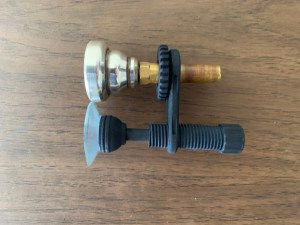
The Stratos is a device that is designed to attach to the shank of your mouthpiece. An adjustable rod with a suction cup then is set so that it rests against your chin while you play. There is some give with the chin rest due to a spring set up inside, but the general idea is that it will keep you from pressing the mouthpiece hard against the lips. There are two versions. The original is called the Stratos Encore Pro and costs £249.99 ($313.04 currently). A less expensive version, 3D printed I believe, is called the Stratos Performer and costs £79.99 ($100.17). They aren’t cheap and that doesn’t include shipping costs.
The inventor, Marcus Reynolds, is a U.K. based trombonist of some note. His embouchure bonafide comes from his experiences relearning how to play following an accident which pushed his mouthpiece through his top lip. After an operation he also apparently developed focal task specific dystonia in the embouchure. He diagnosed his initial return to playing as being held back by “lactic acid trying to repair the scar tissue” and invented the Stratos as a way for him to practice with the mouthpiece rim “hovering” over the scar tissue. Today he has returned to performing professionally and tirelessly promotes the Stratos.
When you order the Stratos Performer it will come unassembled and you’ll have a sheet of paper giving you a brief overview on how to assemble it, as well as a typed out link and QR code to a YouTube video that goes over putting it together. The typed out link was broken, but the QR code did direct me to this video. I did not receive any instructions from Reynolds on how to use the device with my order, so I had to do my own internet searches and reached out directly to him.
What Are the Claims?
Before I go into details on my personal thoughts, I think it’s helpful to take a closer look at the inventor’s claims and learn whether they hold water.
Air Stream Direction
The above video is one of the earlier ones you can find, I think originally made as a DVD that shipped with the original Stratos. Reynolds states:
What should happen is that the air you are buzzing through the mouthpiece should flow through the center of the shank of the mouthpiece. In many cases with amateur and professional alike, this is not necessarily the case and you will not be aware that they is in actual fact being directed by your lips into the bottom of the mouthpiece reducing the power and effectiveness of the air produced making it more difficult to reach the pure note you seek. Especially when you are playing notes in the higher register. If your teeth are not aligned when you play the air produced will be directed downwards hitting the bottom of the cup of the mouthpiece.
While Reynolds does acknowledge upstream and downstream embouchures here, blowing straight into the shank does not happen with well-functioning brass embouchures. The Stratos won’t help you blow straight into the shank, and if it does you’re moving in the wrong direction. This claim has been thoroughly debunked for quite a while – including by one of the sources that Reynolds cites (I guess he didn’t actually read the book).
I asked Reynolds a couple of times about this claim and never got a straight answer from him. It’s possible he’s modified this idea now.
Jaw Position and Teeth Alignment
The prime function of Stratos is to enable you to position your jaw and teeth correctly allowing you to position your lips on the mouthpiece with less pressure and maximum air power with minimal effort and maximum results.
“Correctly” in this context, according to Reynolds, is to position the jaw so the lower teeth and upper teeth are more or less aligned. Lining up the teeth works great for many players, not so well for others. This is personal. Reynolds assumes that what works for his physiology will work for everyone. There are just too many examples of excellent brass musicians who play with a receded jaw to assume that aligning the teeth is correct for everyone.
I think it’s likely that Reynolds allows for different positions of the jaw, including a receded jaw position or even one whether the jaw protrudes so the lower teeth are in front of the upper teeth. However, that’s not how he instructs people to use the Stratos, and it really needs to be made clearer in the instructions if my assumption is correct.
Mouthpiece Pressure
Mouthpiece pressure is more complex than Reynolds gives it credit. It’s been shown that we use more pressure than we realize in normal brass playing and also that we’re terrible judges of how much mouthpiece pressure an individual player is using in the first place.
In my experience excessive mouthpiece pressure is a result of something else not working correctly. When you fix the actual issue the mouthpiece pressure will usually reduce on its own. In fact, many players don’t use enough mouthpiece pressure, particularly in the lower register. Often they have trouble with applying a proper amount of mouthpiece pressure because they are not firming their lips up enough to accept the normal amount of pressure necessary for efficient playing in the first place. Reducing mouthpiece pressure as an a priori assumption is hit or miss at best, you need to understand overall embouchure form and function and the relationship mouthpiece pressure has in the bigger picture.
In other videos Reynolds makes a big deal about reducing mouthpiece pressure so that the blood can flow to the lips. In Part 3 of the original DVD he states, “I think the more blood can get in there the more strength there is. . . This pressure pushes the blood away.”
I don’t have any serious medical training or formal study of anatomy, so you can take my thoughts with a grain of salt. I don’t think Reynolds knows what he’s talking about either, though. I suspect that if we were actually starving the lips of oxygen from lack of blood flow that we would see the lips turning blue and have other more serious issues than a red ring on the lips. Don’t worry about a red pressure ring on the lips from the mouthpiece rim, that happens to a many players and doesn’t suggest you’re using too much pressure.
Why Is This Important?
All of the above premises are dubious claims at best and outright wrong at worst. Now that doesn’t mean that the Stratos is useless, but it was designed under false premises. If the rationale behind why the device was invented is faulty in the first place then it stands to reason that the conclusions of what it’s actually doing are probably wrong too,
The lack of understanding about basic embouchure characteristics such as air stream direction, jaw position, and teeth alignment are huge red flags to me. I don’t feel that Reynolds truly understands brass embouchure technique as well as he thinks and what he suggests that the Stratos is doing for one’s playing is not the case. Nor is what Reynolds recommends going to be correct for many brass musicians.
How To Use It According To Inventor
I mentioned above that I had to go out of my way to find instructions on how Reynolds advises students to use the Stratos. I emailed him for help and he directed me to this video.
In this video Reynolds instructs us to set the Stratos up so that the chin rest and mouthpiece rim are lined up and play some simple scale fragments. Then you adjust it so the chin rest extends just a hair further and repeat. This will supposedly make it so that the higher pitches are as easy to play as the lowest note in the scale. As you continue this process of setting the chin rest even further past the rim you are instructed to keep the jaw forward, even though it’s being pushed back by the chin rest. When you reach this point the mouthpiece will only be lightly touching the lips with very little pressure. Continue until you’re essentially free buzzing into the instrument and practice like that for a bit. Then you pull back the chin rest so that it’s far enough to not contact the chin at all and play. In comparison “the note just flew out,” as Reynolds proclaims when he plays with the chin rest off. You’re supposed to practice about 10 minutes a day like this with the Stratos, then take it off. If you revert back to your “bad habits” you put it back on for a bit.
How well did the above instructions work for me? It was disastrous when I followed it to the letter. I absolutely play better with a receded jaw position and my horn angle tilted down. Starting with the chin rest aligned with the mouthpiece rim was already at the point of where it was sounding terrible and too much effort to play. Sure, I’m not using nearly as much mouthpiece pressure as I usually do, but that’s not really a good thing. I can confirm that when you position the chin rest all the way back and return to playing as normal that the note will “just fly out” like Reynolds claims in the above video. The comparison of how easy it is to play without the Stratos felt easy because I just spent 10 minutes trying to play wrong. It’s like hitting myself in the head with a hammer – it feels good when I stop.
If you’re a brass musician like me who plays best with a receded jaw position you might be able to learn something by practicing in a way that is actually incorrect for a bit, but you’re risking messing up your chops by following Reynold’s instructions. Instead, you should probably start with the chin rest in position where it works best. When I switched to starting with the Stratos set up in my normal playing position I got results more similar to Reynolds’s demonstration video. But that just means it sounded worse and worse until I stopped using the Stratos. Again, it feels better when I stop using it – not because it’s helping me play more efficiently but because I stopped playing wrong.
What It’s Actually Doing and What It Could Actually Be Helpful With
The Stratos does make you play differently, just not in a way that is accurately described by Reynolds. With some understanding of how brass embouchures actually function there are a couple things that the Stratos could have some possible use for.
The best use I found from practicing with the Stratos was using it to provide tactile feedback on the jaw. The position of the jaw is a very important part of a brass musician’s embouchure. For a player with a habit of keeping the jaw in a position that is less than ideal for their anatomy, you could use the Stratos to provide some tactile feedback as to whether the jaw is in the correct placement. For players who open their mouth wide to breathe or drop their jaw to descend you could use the Stratos to again help the player notice more readily when they are pulling their jaw out of the correct position.
But that use needs to first come with an understanding of where the jaw should be for the individual player. I guess you could also use the Stratos to help find the correct position of the jaw by gradually adjusting the position of the chin rest as described above, but I find it easier to simply move the horn angle and have the student follow the horn angle with the jaw while listening to intonation and tone. I’ve had pretty good success helping students find their individual correct jaw position and horn angle without any devices. It’s at least as effective, and a whole lot cheaper.
Other than this form of external feedback on the jaw position, I didn’t find there to be any real value in practicing with the Stratos. Furthermore, I feel that everything that it can do for your embouchure technique can be done just as easily without it, provided you have the background to understand how your embouchure functions correctly.
What It’s Hindering
While I anticipated the Stratos would interfere a great deal with the embouchure motion, I was surprised that it was easier to push and pull my lips and mouthpiece and slightly alter my horn angles than I expected. That said, it still is inhibiting my ability to freely make those necessary alterations and my playing is just a bit sloppier than without it on. Some players might find their embouchure motion is static enough that it’s not a big deal, but I found using it discouraged the correct changes I need. If you need to reduce the amount of embouchure motion and horn angle change that you use there are easier (and cheaper) ways to go about it than using the Stratos.
The instructions don’t go over using the Stratos to find the correct jaw position for a player who correctly plays with a receded jaw. I don’t know for sure if Reynolds would allow for this in a private lesson, but his online videos ask you to start with the chin rest and rim aligned and then protrude the chin rest even further from there. If you follow his instructions literally and happen to be a brass musician who plays correctly with a receded jaw position this is not going to be helpful.
When positioned in a particular way the Stratos does indeed make it so you have to use less mouthpiece pressure. As I mentioned earlier, in my experience it’s more common to find players who don’t use enough mouthpiece pressure, so in this case reducing the mouthpiece pressure is the opposite of what they need to move towards. For players who are using too much mouthpiece pressure there are usually other things that are not working correctly so that the musician is relying on the excessive pressure as a crutch. With an understanding of embouchure form and function you can fix the cause of the symptom and usually the excessive pressure will go away on its own. Simply reducing mouthpiece pressure on its own is treating the symptom and not fixing the actual problem. There may even be some risk of injury for players when they take the Stratos off to play if they don’t make the necessary correction to their embouchure form.
So You Still Want To Learn More
If you really want to learn more about the Stratos it’s quite easy to get in touch with Reynolds. He’s very accessible and seems genuinely excited about the Stratos. You can contact him through his web site and watch his videos on YouTube. He also is the administrator of a Facebook group (mis)named “Brass Embouchure Advice,” which you can search for on Facebook and join if you’re so inclined. Keep in mind any advice you get there is almost certainly going to be recommending the Stratos. Reynolds states, “All my students had success with it. It’s almost a device that cannot not work.” (I don’t believe this to be the case). Advertisements of anything other than an endorsement of the Stratos are prohibited, for the most part. In my experience trying to post in that group I often had long delays in getting my posts approved and actually was banned for a while simply for posting this link.
As I said, Reynolds is easy to reach and enthusiastic about the Stratos. After mine arrived I reached out to him by email and he offered to give me a lesson (he would have charged $100) with a money back guarantee if I didn’t find it helpful. I tried to schedule something with him during my spring break when I had a lull in my schedule, but between both of our busy schedules and the time difference we weren’t able to find a time to get together. It’s possible that my opinion of the Stratos would have changed with a lesson from its inventor, however I feel that I already know enough about brass embouchure technique to understand what the Stratos can actually do and how to do the same thing without it. But you might feel differently and if you are interested it’s probably not too hard for you to make that happen – provided you’re willing to drop over $200 on both the device and a lesson.
However, I feel you’ll need to take Reynolds’s advice with a grain of salt. In his instructional videos and other places online he mischaracterizes brass embouchure technique, often offering contrary descriptions of how things should function. It mostly seems he makes recommendations that describe how he thinks he plays, without consideration of what is actually happening and how it can be different from player to player.
Final Thoughts
The Stratos is expensive, overpriced for the value in my opinion. Everything that I might use it for can be done just as easily, perhaps better, without the device. There are some inherent risks using it that could lead you to habituating something that is wrong for your embouchure. You’ll need to make some effort to find instructions on how to use it, since it’s not obvious when it is shipped to you, unless you want to spend the money to catch a lesson directly with Reynolds. Furthermore, those directions are not universally good for all brass musicians.
My Stratos is now in my junk drawer with old mouthpieces and other things I don’t use. At some point I will probably try it out with a student, just to see what happens, but I won’t use it as suggested by Reynolds and I won’t recommend anyone spend the money to purchase their own.