A recent discussion on TromboneChat discussed playing pedal tones and whether or not it is appropriate to switch embouchure types for playing the pedals. Specifically, whether it’s helpful for a downstream player to change to upstream or vice versa. One participant wrote:
If you are a high placement downstream player, reverse your playing to upstream for pedals. I don’t know how you would do it if you are an upstream player already.
Basically, the airstream needs to aim more or less right at the mouthpiece throat.
First, it’s important to understand and define what upstream and downstream embouchures actually are. Follow the above link to read and watch some details, but to summarize when a brass musician places the mouthpiece with more upper lip inside the mouthpiece the air gets blown in a downward direction. When the mouthpiece is placed with more lower lip inside the air stream direction is blown up. This embouchure characteristic can be found on all functioning brass embouchures, regardless of how the musicians feels is what is happening. It’s not directly related to the position or the jaw, it’s the mouthpiece placement that makes the air stream blown up or down.
It is definitely true that as a brass musician plays lower the air stream will be blown closer towards the shank of the mouthpiece. But I don’t feel it should switch air stream direction. In fact, I don’t buy that this is actually happening with the examples shown or discussed in the Trombone Chat topic. For example, one participant feels that this film of George Roberts playing a pedal F demonstrates a switch from upstream to downstream.
Notice that in this video that Roberts places the mouthpiece so that there’s more upper lip inside. The upper lip predominates and overlaps the lower lip. The film maker, Lloyd Leno, even classifies Roberts as playing with a downstream embouchure. I don’t see anything in this film clip that would indicate Roberts flips his air stream from downstream to upstream for this pedal F. Certainly the air stream is directed closer to blowing straight into the shank, but I don’t think it’s reversing and blowing upstream.
If you’re not convinced, let’s take a look at a bunch of different trombonists playing a pedal Bb. First, let’s look at the more common downstream types.
Downstream Pedal Bb
The above photo captures the aperture close to its most open position and the air stream does look like it might be being blown straight into the shank. Note the slight overlap of the upper lip over the lower.
This player shows a similar lip position as the player above. Both players place their mouthpiece quite close to half and half, perhaps too much so. Again, notice how the lips are lining up. In this case the upper lip doesn’t look like it overlaps quite as much over the lower.
This one doesn’t have the best angle, but you can see the upper lip overlapping the lower lip slightly. Here’s several more.
You get the idea. In the above examples there is more upper lip inside the mouthpiece and the upper lip slightly overlaps the lower. This upper lip overlap is easier to see in higher register notes because the air stream is blown more sharply downward, but the same general lip position is present on the pedals too.
I want to point out that some of the above players reset their mouthpiece placement to a more centered placement to play pedals. This is something I advise against, but it’s important to notice this fact because it is something that happens with upstream trombonists as well.
Let’s compare the downstream players with some photos of upstream trombonists playing a pedal Bb and see if there’s an obvious difference.
Upstream Pedal Bb
The glare off the flash on the mouthpiece along with the position the lip aperture happened to be in makes it a little harder to see, but notice the mouthpiece placement allows for more lower lip inside. This trombonist resets the mouthpiece to a position closer to half and half for pedal range – and example of “shifting” to play pedals that I advise against. If you rely on resetting the mouthpiece for pedals you’re always going to have trouble getting in and out of the pedal register. It’s best to learn to play pedals in a way that matches your embouchure form for the normal playing range.
This upstream trombonist also resets the mouthpiece to a more centered position. You can see the loose right mouth corner. Collapsing the embouchure formation to descend is a common issue. Those features aside, notice the lower lip is overlapping the upper lip slightly. There is a distinctly different lip position compared with the downstream embouchures.
This upstream trombonist has a placement close to half and half for his entire range. I didn’t capture the aperture in a very open position for the above photo, but that is a pedal Bb. Photos of this musician playing higher notes shows it much more clearly as an upstream embouchure. Again, notice the lip position and compare to the downstream players.
This photo got the aperture in a position that makes it easier to note the upstream air direction for a pedal Bb. Notice how the lower lip predominates and overlaps slightly.
Here’s another example. The glare of the flash again gets in the way a bit, but you can see the predominance of the lower lip inside the mouthpiece and the lower lip is slightly in front of the upper. This is opposite of all the downstream examples.
The above photo is me playing a pedal Bb. My friend didn’t quite get the side angle I had with the other photos, so it’s harder to see the lower lip coming out in front of the upper, but you can clearly see how much more lower lip is inside the mouthpiece.
There is a general type of lip position you can see inside the mouthpiece that is different between downstream and upstream brass musicians. If you take the time to look closely at a number of different brass embouchures like this you’ll become adept at spotting the difference. Look closely at the above photographs and also the entire Leno film I embedded above and look for which lip tends to overlap the other. With downstream players the upper lip will be slightly in front of the lower while with upstream embouchures you’ll see the lower lip slightly in front of the upper. It doesn’t matter what the horn angle is or jaw position, the mouthpiece placement makes the embouchure upstream or downstream. Notice in the above photo examples that you can find players with receded or aligned jaw positions playing upstream and downstream.
One thing that you won’t be able to see in just the isolated photographs is that there is a gradual adjustment of the air stream direction from high to low. When a downstream embouchure brass musician plays in the upper register the air stream is blown more sharply downstream and when that musician plays in the lower register the air stream will be blown at a smaller angle downward. This is reversed for upstream embouchures. The Lloyd Leno film I embedded above shows this pretty clearly in slow motion.
So the question is whether or not it’s appropriate to change embouchure types for pedals. As a tenor trombonist, I don’t need to perform pedals very frequently and generally the context in the tenor literature for pedal tones are such that if I did need to reset or make a radical shift in my embouchure to get pedal tones out I probably could. So you could make an argument that as long as this shift doesn’t happen in the normal playing range it’s no big deal.
That said, I think it’s best to avoid any embouchure type switching or radical shifts in embouchure, regardless of what range it’s in. For one thing, shifting back and forth will cause a noticeable break in the embouchure and right at that switch you’ll be able to see and hear something happen. Here is an example of this happening in the normal playing register on a tubist.
Notice the lip position inside the mouthpiece. For his lower register his lower lip predominates and the embouchure is upstream. In the middle of his register he flips lip position and the upper lip begins to predominate and the air will be blown downstream. He’s quite adept at going back and forth, but you’ll hear that he almost always cracks the notes around the break. When asked to play something that happens right at this switch things can easily break down.
This tubist happens to have a mouthpiece placement too close to half and half, so he is unable to keep the embouchure functioning for the entire range as either upstream or downstream. Notice that his type switching happens without a radical change in jaw position or other shift that might be noticeable if you don’t know what to look and listen for.
Something similar can happen for trombonists when they play pedal tones, but the same disadvantages that the above tubist is dealing with apply. Again, you could make the argument that a tenor trombonist who plays pedals infrequently shouldn’t worry too much about playing the pedal range differently, but if that embouchure type switching creeps into the normal playing range it will be more problematic. Regardless, I feel that spending time in the practice room to minimize or eliminate any unnecessary or drastic shifts in embouchure technique is better – even for the pedal register.
For years I’ve been coming across advertisements for the Stratos, invented by trombonist Marcus Reynolds. I first heard about this device about 10 years ago, in 2013, and wrote up my initial thoughts here. In 2014 I came across another video from Reynolds and wrote my impressions of that video here. Reynolds is a tireless promoter and I’ve been seeing more and more of his posts and videos about this device the past couple of years, so I finally broke down and purchased one to see if it lives up to the hype.
Since this will be a long post, I’ll give you the tl/dr version up top – You can save your money. It’s possible that it can be used for a small number of embouchure tweaks, but it’s completely unnecessary and if you use it wrong it has the potential to hurt more than it helps. Using it correctly is harder than you might think. Reynolds’s instructions don’t take individual differences into account or certain embouchure mechanics that the Stratos interferes with.
What is the Stratos?
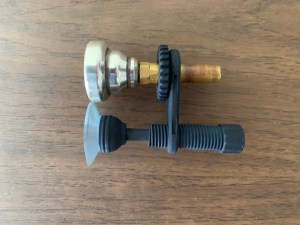
The Stratos is a device that is designed to attach to the shank of your mouthpiece. An adjustable rod with a suction cup then is set so that it rests against your chin while you play. There is some give with the chin rest due to a spring set up inside, but the general idea is that it will keep you from pressing the mouthpiece hard against the lips. There are two versions. The original is called the Stratos Encore Pro and costs £249.99 ($313.04 currently). A less expensive version, 3D printed I believe, is called the Stratos Performer and costs £79.99 ($100.17). They aren’t cheap and that doesn’t include shipping costs.
The inventor, Marcus Reynolds, is a U.K. based trombonist of some note. His embouchure bonafide comes from his experiences relearning how to play following an accident which pushed his mouthpiece through his top lip. After an operation he also apparently developed focal task specific dystonia in the embouchure. He diagnosed his initial return to playing as being held back by “lactic acid trying to repair the scar tissue” and invented the Stratos as a way for him to practice with the mouthpiece rim “hovering” over the scar tissue. Today he has returned to performing professionally and tirelessly promotes the Stratos.
When you order the Stratos Performer it will come unassembled and you’ll have a sheet of paper giving you a brief overview on how to assemble it, as well as a typed out link and QR code to a YouTube video that goes over putting it together. The typed out link was broken, but the QR code did direct me to this video. I did not receive any instructions from Reynolds on how to use the device with my order, so I had to do my own internet searches and reached out directly to him.
What Are the Claims?
Before I go into details on my personal thoughts, I think it’s helpful to take a closer look at the inventor’s claims and learn whether they hold water.
Air Stream Direction
The above video is one of the earlier ones you can find, I think originally made as a DVD that shipped with the original Stratos. Reynolds states:
What should happen is that the air you are buzzing through the mouthpiece should flow through the center of the shank of the mouthpiece. In many cases with amateur and professional alike, this is not necessarily the case and you will not be aware that they is in actual fact being directed by your lips into the bottom of the mouthpiece reducing the power and effectiveness of the air produced making it more difficult to reach the pure note you seek. Especially when you are playing notes in the higher register. If your teeth are not aligned when you play the air produced will be directed downwards hitting the bottom of the cup of the mouthpiece.
While Reynolds does acknowledge upstream and downstream embouchures here, blowing straight into the shank does not happen with well-functioning brass embouchures. The Stratos won’t help you blow straight into the shank, and if it does you’re moving in the wrong direction. This claim has been thoroughly debunked for quite a while – including by one of the sources that Reynolds cites (I guess he didn’t actually read the book).
I asked Reynolds a couple of times about this claim and never got a straight answer from him. It’s possible he’s modified this idea now.
Jaw Position and Teeth Alignment
The prime function of Stratos is to enable you to position your jaw and teeth correctly allowing you to position your lips on the mouthpiece with less pressure and maximum air power with minimal effort and maximum results.
“Correctly” in this context, according to Reynolds, is to position the jaw so the lower teeth and upper teeth are more or less aligned. Lining up the teeth works great for many players, not so well for others. This is personal. Reynolds assumes that what works for his physiology will work for everyone. There are just too many examples of excellent brass musicians who play with a receded jaw to assume that aligning the teeth is correct for everyone.
I think it’s likely that Reynolds allows for different positions of the jaw, including a receded jaw position or even one whether the jaw protrudes so the lower teeth are in front of the upper teeth. However, that’s not how he instructs people to use the Stratos, and it really needs to be made clearer in the instructions if my assumption is correct.
Mouthpiece Pressure
Mouthpiece pressure is more complex than Reynolds gives it credit. It’s been shown that we use more pressure than we realize in normal brass playing and also that we’re terrible judges of how much mouthpiece pressure an individual player is using in the first place.
In my experience excessive mouthpiece pressure is a result of something else not working correctly. When you fix the actual issue the mouthpiece pressure will usually reduce on its own. In fact, many players don’t use enough mouthpiece pressure, particularly in the lower register. Often they have trouble with applying a proper amount of mouthpiece pressure because they are not firming their lips up enough to accept the normal amount of pressure necessary for efficient playing in the first place. Reducing mouthpiece pressure as an a priori assumption is hit or miss at best, you need to understand overall embouchure form and function and the relationship mouthpiece pressure has in the bigger picture.
In other videos Reynolds makes a big deal about reducing mouthpiece pressure so that the blood can flow to the lips. In Part 3 of the original DVD he states, “I think the more blood can get in there the more strength there is. . . This pressure pushes the blood away.”
I don’t have any serious medical training or formal study of anatomy, so you can take my thoughts with a grain of salt. I don’t think Reynolds knows what he’s talking about either, though. I suspect that if we were actually starving the lips of oxygen from lack of blood flow that we would see the lips turning blue and have other more serious issues than a red ring on the lips. Don’t worry about a red pressure ring on the lips from the mouthpiece rim, that happens to a many players and doesn’t suggest you’re using too much pressure.
Why Is This Important?
All of the above premises are dubious claims at best and outright wrong at worst. Now that doesn’t mean that the Stratos is useless, but it was designed under false premises. If the rationale behind why the device was invented is faulty in the first place then it stands to reason that the conclusions of what it’s actually doing are probably wrong too,
The lack of understanding about basic embouchure characteristics such as air stream direction, jaw position, and teeth alignment are huge red flags to me. I don’t feel that Reynolds truly understands brass embouchure technique as well as he thinks and what he suggests that the Stratos is doing for one’s playing is not the case. Nor is what Reynolds recommends going to be correct for many brass musicians.
How To Use It According To Inventor
I mentioned above that I had to go out of my way to find instructions on how Reynolds advises students to use the Stratos. I emailed him for help and he directed me to this video.
In this video Reynolds instructs us to set the Stratos up so that the chin rest and mouthpiece rim are lined up and play some simple scale fragments. Then you adjust it so the chin rest extends just a hair further and repeat. This will supposedly make it so that the higher pitches are as easy to play as the lowest note in the scale. As you continue this process of setting the chin rest even further past the rim you are instructed to keep the jaw forward, even though it’s being pushed back by the chin rest. When you reach this point the mouthpiece will only be lightly touching the lips with very little pressure. Continue until you’re essentially free buzzing into the instrument and practice like that for a bit. Then you pull back the chin rest so that it’s far enough to not contact the chin at all and play. In comparison “the note just flew out,” as Reynolds proclaims when he plays with the chin rest off. You’re supposed to practice about 10 minutes a day like this with the Stratos, then take it off. If you revert back to your “bad habits” you put it back on for a bit.
How well did the above instructions work for me? It was disastrous when I followed it to the letter. I absolutely play better with a receded jaw position and my horn angle tilted down. Starting with the chin rest aligned with the mouthpiece rim was already at the point of where it was sounding terrible and too much effort to play. Sure, I’m not using nearly as much mouthpiece pressure as I usually do, but that’s not really a good thing. I can confirm that when you position the chin rest all the way back and return to playing as normal that the note will “just fly out” like Reynolds claims in the above video. The comparison of how easy it is to play without the Stratos felt easy because I just spent 10 minutes trying to play wrong. It’s like hitting myself in the head with a hammer – it feels good when I stop.
If you’re a brass musician like me who plays best with a receded jaw position you might be able to learn something by practicing in a way that is actually incorrect for a bit, but you’re risking messing up your chops by following Reynold’s instructions. Instead, you should probably start with the chin rest in position where it works best. When I switched to starting with the Stratos set up in my normal playing position I got results more similar to Reynolds’s demonstration video. But that just means it sounded worse and worse until I stopped using the Stratos. Again, it feels better when I stop using it – not because it’s helping me play more efficiently but because I stopped playing wrong.
What It’s Actually Doing and What It Could Actually Be Helpful With
The Stratos does make you play differently, just not in a way that is accurately described by Reynolds. With some understanding of how brass embouchures actually function there are a couple things that the Stratos could have some possible use for.
The best use I found from practicing with the Stratos was using it to provide tactile feedback on the jaw. The position of the jaw is a very important part of a brass musician’s embouchure. For a player with a habit of keeping the jaw in a position that is less than ideal for their anatomy, you could use the Stratos to provide some tactile feedback as to whether the jaw is in the correct placement. For players who open their mouth wide to breathe or drop their jaw to descend you could use the Stratos to again help the player notice more readily when they are pulling their jaw out of the correct position.
But that use needs to first come with an understanding of where the jaw should be for the individual player. I guess you could also use the Stratos to help find the correct position of the jaw by gradually adjusting the position of the chin rest as described above, but I find it easier to simply move the horn angle and have the student follow the horn angle with the jaw while listening to intonation and tone. I’ve had pretty good success helping students find their individual correct jaw position and horn angle without any devices. It’s at least as effective, and a whole lot cheaper.
Other than this form of external feedback on the jaw position, I didn’t find there to be any real value in practicing with the Stratos. Furthermore, I feel that everything that it can do for your embouchure technique can be done just as easily without it, provided you have the background to understand how your embouchure functions correctly.
What It’s Hindering
While I anticipated the Stratos would interfere a great deal with the embouchure motion, I was surprised that it was easier to push and pull my lips and mouthpiece and slightly alter my horn angles than I expected. That said, it still is inhibiting my ability to freely make those necessary alterations and my playing is just a bit sloppier than without it on. Some players might find their embouchure motion is static enough that it’s not a big deal, but I found using it discouraged the correct changes I need. If you need to reduce the amount of embouchure motion and horn angle change that you use there are easier (and cheaper) ways to go about it than using the Stratos.
The instructions don’t go over using the Stratos to find the correct jaw position for a player who correctly plays with a receded jaw. I don’t know for sure if Reynolds would allow for this in a private lesson, but his online videos ask you to start with the chin rest and rim aligned and then protrude the chin rest even further from there. If you follow his instructions literally and happen to be a brass musician who plays correctly with a receded jaw position this is not going to be helpful.
When positioned in a particular way the Stratos does indeed make it so you have to use less mouthpiece pressure. As I mentioned earlier, in my experience it’s more common to find players who don’t use enough mouthpiece pressure, so in this case reducing the mouthpiece pressure is the opposite of what they need to move towards. For players who are using too much mouthpiece pressure there are usually other things that are not working correctly so that the musician is relying on the excessive pressure as a crutch. With an understanding of embouchure form and function you can fix the cause of the symptom and usually the excessive pressure will go away on its own. Simply reducing mouthpiece pressure on its own is treating the symptom and not fixing the actual problem. There may even be some risk of injury for players when they take the Stratos off to play if they don’t make the necessary correction to their embouchure form.
So You Still Want To Learn More
If you really want to learn more about the Stratos it’s quite easy to get in touch with Reynolds. He’s very accessible and seems genuinely excited about the Stratos. You can contact him through his web site and watch his videos on YouTube. He also is the administrator of a Facebook group (mis)named “Brass Embouchure Advice,” which you can search for on Facebook and join if you’re so inclined. Keep in mind any advice you get there is almost certainly going to be recommending the Stratos. Reynolds states, “All my students had success with it. It’s almost a device that cannot not work.” (I don’t believe this to be the case). Advertisements of anything other than an endorsement of the Stratos are prohibited, for the most part. In my experience trying to post in that group I often had long delays in getting my posts approved and actually was banned for a while simply for posting this link.
As I said, Reynolds is easy to reach and enthusiastic about the Stratos. After mine arrived I reached out to him by email and he offered to give me a lesson (he would have charged $100) with a money back guarantee if I didn’t find it helpful. I tried to schedule something with him during my spring break when I had a lull in my schedule, but between both of our busy schedules and the time difference we weren’t able to find a time to get together. It’s possible that my opinion of the Stratos would have changed with a lesson from its inventor, however I feel that I already know enough about brass embouchure technique to understand what the Stratos can actually do and how to do the same thing without it. But you might feel differently and if you are interested it’s probably not too hard for you to make that happen – provided you’re willing to drop over $200 on both the device and a lesson.
However, I feel you’ll need to take Reynolds’s advice with a grain of salt. In his instructional videos and other places online he mischaracterizes brass embouchure technique, often offering contrary descriptions of how things should function. It mostly seems he makes recommendations that describe how he thinks he plays, without consideration of what is actually happening and how it can be different from player to player.
Final Thoughts
The Stratos is expensive, overpriced for the value in my opinion. Everything that I might use it for can be done just as easily, perhaps better, without the device. There are some inherent risks using it that could lead you to habituating something that is wrong for your embouchure. You’ll need to make some effort to find instructions on how to use it, since it’s not obvious when it is shipped to you, unless you want to spend the money to catch a lesson directly with Reynolds. Furthermore, those directions are not universally good for all brass musicians.
My Stratos is now in my junk drawer with old mouthpieces and other things I don’t use. At some point I will probably try it out with a student, just to see what happens, but I won’t use it as suggested by Reynolds and I won’t recommend anyone spend the money to purchase their own.
If you have already contacted me about tomorrow’s brass embouchure Zoom hangout you should have gotten an email from me with the Zoom link. If you didn’t get it, please make sure you’re checking the email account you reached out to me and look in your spam folder, just in case.
If you can’t find it, please reach out to me again and let me know. If you didn’t let me know you’re interested already and want to participate let me know and I’ll send you the Zoom info.
There were two days/times that tied for being the most convenient for people to attend, so I arbitrarily chose Tuesday, April 4, 2023 at 1 PM eastern (5 PM GMT).
This is a free Zoom “workshop” where I will spend about an hour discussing basic brass embouchure patterns and what I think the pedagogical implications of understanding how brass embouchures function. Afterwards we’ll spend time just hanging out and informally discussing brass pedagogy and playing, including taking the time to determine participants embouchure types and discussing troubleshooting specific problems.
If you want to attend please fill out the below form with your name and email. I will email you a Zoom link, probably on Monday.
Participants are encouraged to have your instruments around for the informal discussion. As I mentioned, I would like to take the time to play “guess the embouchure type” and see if we can offer some helpful advice for players and teachers working with brass embouchure issues.
Back a couple of years ago, when the pandemic lockdown was happening, I put together a couple of Zoom lectures to discuss brass embouchure pedagogy. I’ve been considering doing this again, so here’s an online poll to assess both the level of interest in participating and when a good day/time would be. This would be free, but I will ask you to register at a later date. Choose as many of the following options as you want.
Update – The poll is now closed. The Zoom hangout will happen on Tuesday, April 4 at 1 PM Eastern (5 PM GMT). See this post for info on how to get into the Zoom meetup.
The exact times might fluctuate, so instead of 10 AM maybe I’d start it at 10:30 or 11:00. So if the time frame is close, but maybe within an hour of when you think you could make it, go ahead and indicate the time that is close for you and leave a comment here with your hoped for start time. Last couple of times I did this we went a couple of hours, so I expect that we’ll hang out about the same length of time.
You might need to be logged into WordPress or otherwise be a registered commenter on my blog here to participate, I’ll try to test this later. If you’re having issues submitting your requested days/times, you can always just reach out to me through my contact form instead.
Ask a bunch of brass teachers how to make changes in instrumental technique and you’ll get a lot of contrasting advice, but if there is a consensus of sorts it seems to favor developing a good sound concept and allowing the body to figure itself out. I’ve written many times about why I feel this approach is not ideal, including looking at research that investigates how we learn and develop motor skills. The trouble with utilizing that research to design teaching and practice strategies for musicians is that a large part of that research is tested using skills that are new to the test subjects. What is the best way to make changes or refine a skill that is already developed? I recently came across an article published in 2016 in the Journal of Applied Sport Psychology that takes a close look at that question and offers a five part model for making corrections to a skill already learned.
We do need to keep in mind that this article is specifically looking at athletics and not music performance and pedagogy, but I think that the psychology between instrumental technique and athletic skills is similar enough that we can use the same strategies. With that caveat in mind, here’s a look at the five part process for refining technique.
Step 1 – Analysis
Yes, the first step is to analyze the musician’s technique. Right off the bat some brass teachers are going to flinch when they read this. For many, analysis is seen as a bad thing and it leads to “paralysis by analysis.” I find this attitude silly, to be honest. If you or a student is freezing up when playing mechanics are getting a close look for how efficient it’s working then you’re doing the analysis wrong in the first place.
The analysis step is vital for a couple of reasons. First, we need to be able to assess if playing difficulties are due to a mechanical issue in the first place. Furthermore, the analysis process should identify the precise cause of a technique flaw in an objective manner. Too many brass teachers are too quick to assume that the issue is being caused by incorrect breath control or maybe a poor sound concept. Those things can result in inefficient technique, but there are other areas in brass mechanics that also need to be analyzed and addressed.
One point the article mentions that I think is important here is that the athlete’s (or musician’s) technique should be analyzed separately from an attempt at correction. In other words, the musician’s attention should not be on the playing mechanics being addressed while analyzing the technique. It’s best is the coach (teacher) is the one doing the analysis. It’s notoriously difficult to analyze your own issues, so if that’s necessary it’s probably best done by recording your playing and doing your analysis away from the act of playing your instrument.
Also addressed in the article in this stage is getting the athlete (musician) to buy into the process here and recognize that there is a technique flaw that needs to be dealt with. Since there is typically a drop off in performance that happens during the next stage due to the technical refinement being new it’s important that the musician understand why the change is necessary, what specifically to change, and how to make that change.
Step 2 – Awareness
The goal in this step is to deautomate the instinctive inefficient technique. When the habitual way of playing the instrument isn’t working properly it needs to be replaced by the correct technique and that requires the musician (or athlete) to be aware of the technique in the first place.
To deautomate the aspect of technique requiring refinement (hereafter termed the target variable), athletes are required to consciously apply a narrow and internal focus of attention (cf. Wulf, 2013), which enables access to the relevant movement component within the memory trace (Christina & Corcos, 1988). If control over the target variable remained largely subconscious, as is thought ideal for performance (Csikszentmihalyi, 1990; Swann, Crust, Keegan, Piggott, & Hemmings, 2015), it would be difficult to see how any long-term changes could be initiated. Indeed, Rendell, Farrow, Masters, and Plummer (2011) have demonstrated the limitations of implicit strategies in this particular context. More specifically, athletes counting the number of tones overlaid on music soundtracks (i.e., an effort not to think about the movement) during netball shooting practice to a higher than regulation ring led to an eventual lower ball flight trajectory instead of an intended higher trajectory, despite athletes not being aware of any change taking place. In short, a conscious focus seems to be an essential precursor of effective motoric change.
Implementing the Five-A Model of Technical Refinement: Key Roles of the Sport Psychologist – Howie J. Carson & Dave Collins
The bold emphasis in the above quote is mine in order to highlight the difference between this evidence based strategy compared to the approach many brass teachers take where they intentionally keep their students awareness off the specific mechanical skill. Traditional brass pedagogy skips this step.
One reason why I think many teachers intentionally avoid the process of helping a student become aware of their playing mechanics is that there is almost always a drop in performance when a change in motor skills is made. Where many brass pedagogues assume this decline is an indication that the awareness is making the problem worse, sports psychologists see this as a necessary step in the process. Music students need to be aware of what the purpose of this stage is and be realistic in their expectations.
The authors recommend contrast drills as providing good benefits in this stage of the process. Practicing this way involves spending some time alternating between the old and incorrect way of playing and the new and more efficient way.
Contrast drills challenge athletes for two main reasons. First, a movement component that has been under largely subconscious control must return to consciousness (i.e., executing an already existing technique under a different type of control); second, athletes must consciously manipulate their movement to achieve a new technique. As such, executions are performed with an imbalance of control and require a high degree of concentration and motivation. Using paradoxical training interventions (i.e., asking an athlete to purposefully make an error; see Bar-Eli, 1991) as one way to explain the intended outcome (see also Carson, Collins, & Richards, 2016), contrasts between techniques enable the coach to “reframe” the situation and the athlete to realize what is required to make the change, that is, to fully notice the difference.
Implementing the Five-A Model of Technical Refinement: Key Roles of the Sport Psychologist – Howie J. Carson & Dave Collins
Again, we can compare the emphasis on conscious manipulation of the technique recommended above to the more popular idea in brass pedagogy of discouraging any conscious manipulation of playing mechanics.
Step 3 – Adjustment
In this stage the goal is to make the specific change in technique. The musician (or athlete) becomes familiar with the new technique and how it feels and works when correct. The authors recommend feedback be provided to the student in the form of both recorded trials with the new technique as well as through questions, primes, and verbal instructions that guide the preferred technique.
Contrast training is adjusted in this stage so that the old versions of the playing technique are phased out in favor of the new and correct way of playing.
It has yet to be investigated, but we feel that attempts to unconsciously shape the new behavior, through solely implicit, constraints-based coaching, for example, are less likely to generate effective outcomes such as long-term permanency and robustness under stressful conditions. This may well necessitate a change of behavior by the coach if they are devoutly convinced by this approach, and the psychologist can help greatly by supporting the necessary approach.
Implementing the Five-A Model of Technical Refinement: Key Roles of the Sport Psychologist – Howie J. Carson & Dave Collins
The above quote notes that there are many athletes and coaches who favor an unconscious approach at this stage, but the author’s feel that this approach is less effective in the long term. I agree with their assessments here, but will reiterate their point that further research is needed in this area.
Step 4 – (Re)Automation
Only after the conscious adjustment is made to playing technique do the authors recommend working on making this change automatic. At this stage continuing to break up the playing technique or motor skill into individual steps becomes detrimental in situations of stress (i.e., a performance or audition). Instead, in this stage we finally begin to make the new way of playing internalized.
Music teachers frequently coach their students through mental imagery and analogy. I’ve often pointed out that this is a double edged sword. It’s not helpful in the earlier stages, but at this point it is a necessary step. It’s at this point where the teacher helps the student to perform the technique without conscious effort on playing correctly. This is the stage where the implicit approach takes over.
Step 5 – Assurance
In this final stage the goal is to generate complete confidence in the athlete (or musician) in the unconscious execution of the corrected technique. The student gets regular reassurance from the coach or teacher that new change is working correctly. Assessing the new technique through challenges involving physical fatigue or otherwise “pressure testing” the student is valuable in this stage. This is the point where the musician or athlete just concentrates on the end goal of making good music or putting the ball into the basket.
Final Thoughts
The authors note a specific pet peeve of mine in the typical strategy employed by most brass teachers, separation of the psychology of performing with an accurate understanding of motor skills.
First, there is a distinct need for sport psychology and motor control knowledge to be reconsidered in unison. Unfortunately, in our view, this separation has been driven by too narrow a focus in each case—emotion and cognition in the former and co-ordination dynamics in the latter. Bridging this gap, recent efforts have been made to examine the effects cognition over elements of the movement execution. Carson and Collins (2014, 2015) recently termed this study “psychomechanics” and have explored relative states of automaticity through use of intraindividual movement variability as an indicator of such control (e.g., when executing golf shots with a ball or as intentional practice swings; Carson, Collins, & Richards, 2014b). In short, planned training designs must address not only the development of task-specific cognitive strategies but also how the execution may be embedded with relative permanence and pressure resistance (cf. Carson & Collins, 2016).
Implementing the Five-A Model of Technical Refinement: Key Roles of the Sport Psychologist – Howie J. Carson & Dave Collins
Tip of the hat to Noa Kageyama of the Bulletproof Musician podcast and blog for posting about this article.
I’m not going to link to the web page in this post. I don’t really want to bring more attention to it than I’m already going to do. If you really want to find it, I’m sure that searching the internet will get you to it. But I often see this happen – a music teacher giving medical advice about maladies that seem (to them) to be related or somehow connected with brass playing, even though the music teacher is unqualified (and probably wrong).
So let me start with my usual disclaimer any time that I discuss heath issues. I’m not a medical doctor and I’m not qualified to offer medical advice. I won’t be giving you any medical advice here, beyond the suggestion that you should consult with a medical professional for health issues. I would never trust my doctor, dentist, or some other medical professional to suggest how I can improve my tone or which alternate position to use, that’s not their area of expertise, it’s mine. So why should a music teacher feel that giving students medical advice is OK?
This part of the website is to provide information for musicians who suffer from physical conditions, especially those symptoms known as asthma, Bell’s Palsy, and focal dystonia. For some readers, the solution that I’m offering will sound too good to be true. They may even get angry, convinced that no single process can solve such seemingly different conditions.
No citation on purpose – don’t go to this web page for medical advice
It’s not that I’m convinced no single process can cure the above conditions (which is doubtful) as much as I’m upset that the above individual is acting in an irresponsible way. This person should be ashamed. If a student decides to forgo real medical advice for a serious condition because the student believes the above garbage there can be real harm. Asthma attacks can kill. What a non-expert thinks is Bell’s palsy could actually be a stroke. There are serious consequences here.
I’ve been down this road before…
No citation on purpose – don’t go to this web page for medical advice
Yes, this person has been criticized for offering misinformation about health and medicine before. Rather than consult with a professional about it and get facts straight, this individual chooses instead to double down and continue to mislead students.
The bottom line is, I don’t make claims without first doing research and obtaining evidence.
No citation on purpose – don’t go to this web page for medical advice
This individual doesn’t provide any citations or links. “Research” isn’t about looking on the internet for information that supports your preconceived ideas, it’s about subjecting a hypothesis to an honest test in an attempt to falsify your idea. If it withstand scrutiny, then you might be on to something. If it doesn’t, then you need to revise your hypothesis. If you have evidence in the way of citations, then put them in your essay. Don’t make outrageous claims and that you say are based on “research” and “evidence” unless you provide them.
Out of curiosity, I looked up what research on the benefits of playing a musical instrument says about treating asthma with playing a wind instrument. The problem with searching the internet (or even an academic library) is that you’ll find a lot of references to journals of dubious quality. This is an issue in all academia, music research included. “Publish or perish” run rampant through academia, so many predatory journals have sprung up over the past couple of decades that publish poor quality research or are biased towards a particular viewpoint. If you want to find a “journal” that supports your position or a quack who agrees with you, it’s not too hard to do so.
This is particularly a problem with journals that are specifically devoted to so-called “complimentary and alternative medicine” (CAM). Do you know what medical professionals call complimentary and alternative medicine that has been proven to be both safe and effective? Medicine! There’s no need to separate it unless you’re trying to brand your treatment, which is what CAM really is – a marketing term not a medical one. But here’s what one article in a journal devoted to CAM has to say about asthma and wind instruments.
The literature search identified 867 citations, from which 8 (three RCTs and five nRCTs) low and high risk of bias studies were included in the review. All RCTs used music listening as a form of complementary treatment. One RCT of the low risk of bias indicated positive effects on lung function in mild asthma. In two others, despite the decrease in asthma symptoms, music was not more effective than the control condition. In two nRCTs a decrease in asthma symptoms was reported as an effect of playing a brass or wind instrument; in two nRCTs the same effect was observed after music assisted vocal breathing exercises and singing. Mood improvement, decrease of depression and anxiety were also observed.
The paucity, heterogeneity, and significant methodological limitations of available studies allow for only a weak recommendation for music therapy in asthma. This study highlights the need for further research of mixed methodology.
The bold emphasis above is mine. If a journal devoted to CAM, like the one I quoted from above, is finding only weak results then you have to be a particularly stubborn or ignorant crank to claim that trumpet playing will treat or cure asthma. Or, more likely, you’re not really searching the literature well and simply looking for things that already support your preconceived notions.
Continuing with our misinformed music teacher:
Common health conditions, as labeled by the medical community, are frequently only a side effect of a hidden, more primary cause.Further, when you make a correction at the level of the primary cause, the side effects typically disappear.
No citation on purpose – don’t go to this web page for medical advice
Again, this individual offers no citations, but I’m not sure that the above criticism is even accurate. Medical professionals are very much interested in helping patients with correcting the cause of symptoms. I think it’s pretty well understood by doctors that curing a disease or disorder involves finding the cause and eliminating it.
In the case of our sample trio of conditions – asthma, Bell’s Palsy, focal dystonia – what is the cause? Ask a medical doctor. He will say, “We don’t know the answer to that yet.” The best he can offer is symptom management, in the hopes that somehow the body eventually heals itself. Of course, from his frame of reference, that means drugs, which not only don’t ever cure anything, but actually lead to the creation of more problems. As the old alternative health saying goes, “the body is not crying out for more drugs.”
No citation on purpose – don’t go to this web page for medical advice
It is true that medical science doesn’t always have all the answers about what causes the above listed disorders, but they have good ideas and I trust the judgement of scientists who have devoted their education and careers to learning more about disease and how to cure them. Sometimes managing symptoms and allowing the body to heal itself is the best treatment. Symptom management may be a stop gap in some medical cases, but if you suffer from asthma, for example, a prescribed drug may just save your life. A music teacher who actively discourages taking medically prescribed drugs is behaving recklessly.
Regardless, just because the causes of a particular disorder like focal dystonia isn’t understood by medical science doesn’t mean that a music teacher has a better idea. In fact, I imagine that a music teacher has a much less chance of understanding medical issues.
My day job is still [music] teaching. However, an increasing amount of my time is spent investigating the brain.
No citation on purpose – don’t go to this web page for medical advice
This individual has no business pushing crackpot ideas on neuroscience, no matter how much “research” this individual pretends to be doing. At what point should a music teacher be believed over someone who spent 8-10 years in school studying medicine, a year of residency, and multiple years or decades of clinical practice or scientific research on neuroscience?
As it turns out, a high percentage of chronic health issues actually stem from the negative mental environment created by a single, correctable brain condition – hyperpolarity of brain functioning.
No citation on purpose – don’t go to this web page for medical advice
Again, there are no citations provided for what “high percentage” of health issues are caused by “hyperpolarity.” This is getting dangerously close to blaming the victim for health issues that they have no control over.
Note: Hyperpolarity of brain functioning is not taught in medical schools. Nor will you find it in any medical literature. In short, it is not recognized as a medically treatable condition.
No citation on purpose – don’t go to this web page for medical advice
This person doesn’t define “hyperpolarity of brain function.” A brief search for scholarly articles on “hyperpolarity brain” actually comes up with a number of hits. I haven’t bothered to read any of them, but it actually appears that hyperpolarity is recognized by medical schools. Here’s a link to a definition and short video explaining hyperpolarity and membrane potential put together by Dr. Marc Dingman, who actually earned his PhD in neuroscience, unlike our misinformed music teacher.
So, the advice I give you regarding hyperpolarity can in no way ever be misconstrued as “medical advice.” This is as close as I get to offering a disclaimer. 🙂
No citation on purpose – don’t go to this web page for medical advice
That above quote is what pushed me over the edge and prompted this rant. It’s incredibly disingenuous. You can’t have your cake and eat it too. Suggesting someone who has been prescribed drugs for a serious medical condition does more harm than good and then later stating you’re not offering “medical advice” is devious and reprehensible.
Elsewhere, this same individual wrote, “I do not have – nor do I want to have – a medical degree.” If you’re not willing to put in the hard work and learn to understand medical science, then you have no business talking about it. Particularly when it is contrary to the advice of those who have put that time in to become certified medical professionals. You might think, what’s the big deal? I invite you to look through this web site and understand the harm it causes. This person is openly advocating that prescribed medication for asthma and other maladies “actually lead to the creation of more problems.” Do not believe anything this person says about health! To be honest, I don’t really trust much of this person’s ideas on music either, but at least crazy ideas about music don’t end up killing people.
Purveyors of misinformation like the individual I’m complaining about deserve to be marginalized. Their b*******t needs to be called out for what it is. If you are looking for health advice, talk with your doctor, not a music teacher. Especially not this one.
I’ve posted about the Trumpet Gurus Hang Youtube channel before here. Every week José Johnson brings in a trumpet player or teacher to talk making music. The latest episode features Rich Willey. Rich is based in the same area as me, so we have played together many times. Rich also studied extensively with Donald Reinhardt, one of the primary sources of my dissertation research. He is also currently working with my mentor, Doug Elliott, who’s teaching and pedagogy helped me break past my own musical hurdles and strongly influenced the way I teach.
Check out this episode to learn a little more about Rich and Reinhardt’s teaching.
In my last post I discussed horn angle changes that brass players will make while changing registers. If you haven’t read that post yet, I recommend you do so first so that you will better understand why these exercises are helpful and how to alter them to fit your own embouchure technique or those of your students.
Briefly, all brass players will push and pull their lips up and down with the mouthpiece rim along the teeth and gums while changing registers. The general direction of this “embouchure motion” is up and down, but the direction that the musician pushes or pulls to ascend can be different from player to player. Some brass musicians push up towards the nose to ascend and others pull down. But even within these two basic variations, most players have at least a little side to side motion that happens as well, although it should probably always function in a straight line. In the hypothetical example to the side the musician pushes up and to the right to ascend and pulls down and towards the left to descend.
Because teeth and gums are not a flat plane the horn angle will need to adjust while making this motion in order to maintain the stability of the teeth and gums underneath the mouthpiece rim and lips. The horn angle change, in combination with the above mentioned embouchure motion, helps the musician play a particular pitch with less effort and more in tune. See my post on Horn Angle Changes For Brass for details on what is going on and how to test individual players.
Once you’ve worked out the proper embouchure motion and horn angle changes for a particular student there are exercises that can be done to help the brass musician internalize those changes and make them part of their subconscious technique. With students more prone to freezing up or otherwise having difficulty concentrating on “how” to play can be advised to more their focus to as external a focus as possible. In other words, instead of concentrating on keeping the embouchure “legs” stable by putting more weight on one side of the mouthpiece rim, get the student to aim the bell of the instrument at a point along the wall across from them.
Octave Slurs
I usually don’t bother writing out the specific octave slurs, since it can depend on the current abilities of the student, but you can see some basic examples in the image to the left. I usually also have each set (between the “railroad tracks,” which indicate to stop for a moment and rest) repeated, but starting on a different pitch for each repeat. For example, play the first two measures as written (C in the staff to C below the staff) and then repeat it, but slur from the low C to the middle C. When you get to the sets that span two or more octaves repeat starting on each pitch (e.g., C in the staff, C below the staff, and C above the staff).
I will often use octave slurs as my warmup and have them be my first notes of the day. For each pitch there is a particular spot on the embouchure motion “track” and the accompanying horn angle change where the note sounds best and feels easiest. While practicing octave slurs you can watch yourself in a mirror or aim the bell or slide at spots along the wall to help you visualize where each octave sounds best. Work on keeping the amount of change the same between octaves, just moving in a different direction to ascend and descend. Play them slowly enough that you can make the small adjustments you might need at first to get every note in its correct spot. Over time you’ll find it easier to move to the correct angle change right away.
Spiderweb Routine
The Spiderweb Routine is one of Donald Reinhardt’s exercises. Again, it’s not really necessary to write this all out and the particular pitch you use as the center of the “web” will be different, according to the individual student’s particular needs and goals. In the example to the right the center of the exercises is the Bb on top of the bass clef staff. It starts by slurring up a half step (repeated) and then slurs down a half step. Then up a whole step and down a whole step. It continues with a minor 3rd and so on until each slur is an octave.
Use the center of the “web” as home base for horn angles and embouchure motion. At first, when the intervals are small, there will be very little change to the horn angle. When the interval starts to get to be a perfect 4th and larger you should start to notice the appropriate angle changes. On the first time through each set the student can make small adjustments to the horn angle to make sure that it’s in the most efficient spot for that particular note. On the repeat strive to make the horn angle go to its correct position right away. Pay close attention to the amount of change by watching in a mirror or noting where the bell is pointing. Make the amount of change be the same to ascend an interval as it is to descend the same interval, just in the opposite direction.
As I mentioned above, the center note of this exercise can change according to the student. For players who have the anatomy suited for a Very High Placement or a Low Placement embouchure types I generally recommend a higher starting pitch. For me, I usually practice this exercise starting on the F above the bass clef staff and often use this as my first notes of the day.
I also tend to not practice this exercise just by itself in its entirety, depending on what my goals of the practice session are. The Spiderweb Exercise is part of a larger routine that Reinhardt used that he called Warmup #57 (he probably had a reason for that number, but I don’t know exactly why). In that routine you would play through four sets of the Spiderweb exercise (e.g., up and down a half step, then up and down a whole step), then play through one overtone flexibility study in 4 or more positions/fingerings, then play some ascending chromatic exercises before resting a few minutes. Then when you come back you repeat that patter, but now the Spiderweb Exercise is up and down a minor 3rd and then up and down a major 3rd before switching to the other exercises, rest, and continue. In other words, the whole routine is sort of like circuit training in that you’re touching on three different types of exercises, resting, then repeating each of those exercise types but expanding them in range.
The Spiderweb Routine can be a pretty strenuous exercise to play in its entirety, so it can be a good one to use if your practice time is limited and you want a good workout for your chops. But if you have even less time or want to spend more time on other materials you can skip certain sets in it so that you’re slurring first in minor 3rds, then augmented 4ths, major 6ths, and then octaves (these notes would end up creating a fully diminished 7 chord, by the way), or any similar sort of combination. I would recommend, however, that whatever interval you slur up to that you also practice the same descending interval. Use that as a chance to check and see if your horn angles are consistent between the intervals as mentioned earlier.
Embouchure Motion Stabilizer
This exercise is a variation on another one of Donald Reinhardt’s. You can read more about Reinhardt’s original exercise here. My variation starts on a higher note (one octave higher) and ascends first, rather than descending. Remove the mouthpiece and rest a moment at the “V.” Similar to the other exercises above, play the slurs slowly enough to give yourself time to make those small adjustments to your horn angle and observe the angle with a mirror or by sighting along your bell. On the repeats strive to go directly to the most efficient angle right away.
Ultimately, it’s not as much what you practice, but how you practice that is important. What these three exercises have, however, is they incorporate large enough intervals that the horn angle changes should be noticeable to both the teacher and player and they are simple enough so that the student can play them and keep the attention on making the horn angle changes (or, for that matter, the attention can be brought instead to tongue position, breathing, embouchure motion, or whatever fits the needs and goals at the time). The point here isn’t to teach yourself how to focus on horn angle, it’s to internalize the correct horn angles so that attention can be on something else, like music. I wouldn’t practice an etude or solo repertoire with horn angle changes in mind, but if it’s helpful you could also address horn angle changes then too. If, for example, there’s a large interval leap in a solo you’re working on you might draw an arrow over the note after the leap in the direction you want to move your horn angle to remind yourself to bring that horn angle to its correct spot. But generally speaking you want to use something simple and unmusical for this sort of technique practice, then forget all about it when you’re done with it for the session and work on other things, including sounding good.
If you look at a large enough number of different brass musicians play over their entire range you’ll notice that some of them will noticeably alter their horn angle when changing register. Some will do this to a large degree, others appear to not do so much at all. Some players might appear to tilt their instrument bell up to ascend, while others might do the opposite. Many players even bring their horn angle side to side as well.
What’s going on here? What’s correct? How much should a brass musician worry about this when practicing? How much should a teacher understand?
One of the first things to consider with regards to a horn angle change is the position of the lower jaw. Donald Reinhardt wrote,
The principal duty of the lower jaw while playing is to provide an adequate playing base or foundation so that both the inner and the outer embouchures may function as one solid synchronized unit, regardless of the player’s type classification. This playing base must hold intact while the jaw is protruded and receded (according to the register being played), regardless of any jaw malocclusion that may exist in the player’s jaw formation.
“Encyclopedia…,” p. 152
Reinhardt at times would advise his students to exaggerate the horn angle changes in order to encourage the correct jaw manipulation. So for Reinhardt, getting a student to change the horn angle was often a way to encourage the correct jaw position for the student. He didn’t want the student to be thinking about the jaw while playing so much, so by altering the horn angle the jaw would need to move into its correct position in order to maintain the foundation of the teeth and gums under the lips and mouthpiece rim (which Reinhardt often referred to as the “legs” of the embouchure, likening it to the four legs of a table or the three legs of a tripod). This tracks with what researchers who study the development of motor skills say about keeping your focus as external as possible. You could concentrate on the sensation of your embouchure “legs” by paying attention to how the rim is in contact with your lips, but Reinhardt wanted to move the focus outward, towards the bell of the instrument instead.
There does appear to be a direct relationship between jaw position and horn angle, but this can be personal to the individual brass musician. Many players will, for example, protrude their jaw slightly to ascend and recede it to descend and the horn angle should follow the jaw in order to maintain the “legs” of the embouchure. But almost everyone has a malocclusion to a certain degree and the jaw will often also move from side to side. Watch this trumpet player very closely and note how his jaw moves both in and out and side to side as he changes register, but also note his horn angle.
The view from his side shows that his jaw comes forward slightly as he ascend, while he also brings the horn angle lower, which seems opposite of what you might expect (more on this topic below). But I find the front view a little more interesting and helpful to demonstrate side to side angles. Notice that as he ascends his jaw moves to his left and when descending his jaw moves to his right. But his horizontal horn angle remains pretty static. Watch it again and listen for the intonation and tone on the higher and lower pitches. Does it sound just a little pinched and flat on the high C to you?
For fun, I asked him to play the same slurs, but to also try bringing his horn angle over to one side and compare what happens. Notice that when he slurs from the middle C to the high C he still brings his jaw over to his left while ascending. When he also changes his horn angle towards the right to ascend I feel the pitch is more in tune and the tone more focused. When he brings his horn angle to the left to ascend (the same direction his jaw is moving) the pitch on the high C is definitely flat. The effect is easier to see. Bringing his horn angle to his left to descend helps the low C to be more in tune and focused while bringing his horn angle over to his right (the same direction his jaw is moving) obviously chokes off the note.
This sort of side to side horn angle change is often accompanied with a jaw movement side to side as well and it seems to work best when those two things happen in the opposite direction. If the jaw is moving to the right to ascend, then the horn angle should probably move to the left. This seems to be universal for all brass players with some side to side motion in the jaw/horn angle. When this is working efficiently, according to the individual player’s variation, it can also minimize both the jaw change and horn angle change when they work together. It can also help correct some other mechanical issues. For example, for years I would have to reverse the direction of my embouchure motion to play a pedal Bb. It made playing down in my low register difficult for me. When I began to practice bringing my horn angle to my right while allowing my jaw to move to my left the reversal of embouchure motion direction began to minimize and is almost eliminated for me now.
Speaking of the embouchure motion the way a player pushes and pulls their lips and mouthpiece together along the teeth and gums while playing directly influences the correct horn angle as well. Consider again having the “legs” or the feeling of the rim against the teeth and gums. Our teeth and gums are not a flat surface. There’s some curvature to it, both along the horizontal and vertical. A player’s most efficient embouchure motion is usually also not straight up and down, there’s almost always at least a little side to side variation as well. When changing registers and making the correct embouchure motion a player should follow the shape of the teeth and gums underneath the mouthpiece rim and lips. If while ascending, for example, the brass musician pushes up and to the right the horn angle will probably work best if it comes up slightly and moves to the right as well, following the teeth and gums underneath.
Think of a ball and socket joint. The mouthpiece is like the socket while the musician’s teeth and gums are like the ball. When the socket/mouthpiece are pushed up and to the left it follows the shape of the ball/teeth and gums. It’s not the horn angle that dictates the embouchure motion as much as the embouchure motion dictating how the horn angle needs to change.
Since everyone is going to have different anatomy, everyone’s horn angle will be unique to the individual musician. But there are methods that teachers and players can use to help work out what works best. I’ve touched on this topic in my Embouchure 101 resource, but I’ll briefly describe how I currently work with students to help them with their horn angles.
I will ask a student to sustain a note and move their horn angle around left and right and listen. I want to see how far the musician can bring the horn angle to either side as well as hear what this does to the tone and pitch. If the pitch goes flat when the angle is brought to the left it will probably go sharp when brought to the right. Somewhere in between will be where the pitch becomes most in tune and the timbre will be the most focused. Then repeat on the same note keeping the horizontal horn angle where it is, but tilt the horn angle up and down finding where along the vertical access where the pitch is most in tune and tone is most focused. You can also try moving the bell of the instrument around in a circle, starting with a very big circle and then making it smaller and smaller, circling in on the best angle for the particular note. Repeat on higher and lower notes. I use pitches along the open fingering/1st position partials.
Each note will have it’s own horn angle that makes the pitch play best and assuming that overall embouchure form is working well enough and that the breathing and tongue arch aren’t getting in the way you’ll also note the individual player’s pattern. The horn angle will change gradually along one direction as the notes ascend and gradually in the opposite direction as notes descend. Typically the amount of horn angle change to ascend an octave from a particular pitch will be the same as descending from the same starting pitch, just in the opposite direction. If it’s not, try to see if minimizing the angle change in one direction or making more in the opposite direction works. As a starting point, I feel it’s best to keep these angle changes consistent between octave, similar to working with the player’s embouchure motion.
In summary, everyone will have their own unique changes of horn angle while playing because everyone has different facial anatomy. The player’s horn angle is determined primarily by the shape of the musician’s teeth and gums underneath the mouthpiece rim and lips and angle changes help provide the player with a firm foundation on the teeth and gums for the rim and lips. Some players will tilt their horn up and down more while others may bring their horn angle from side to side more. The amount of horn angle change a musician needs can vary from player to player, but it will generally be close to the same amount to slur up an octave as it is to slur down an octave from the same note. A teacher can help a student work out the best horn angles by watching and listening to the student move the horn angles left to right and up to down, paying attention to where the pitch goes and where the tone is most focused.
The next post will discuss some exercises that a brass musician can use to solidify horn angle changes and make them work subconsciously so that the musician can concentrate more on playing more expressively.